
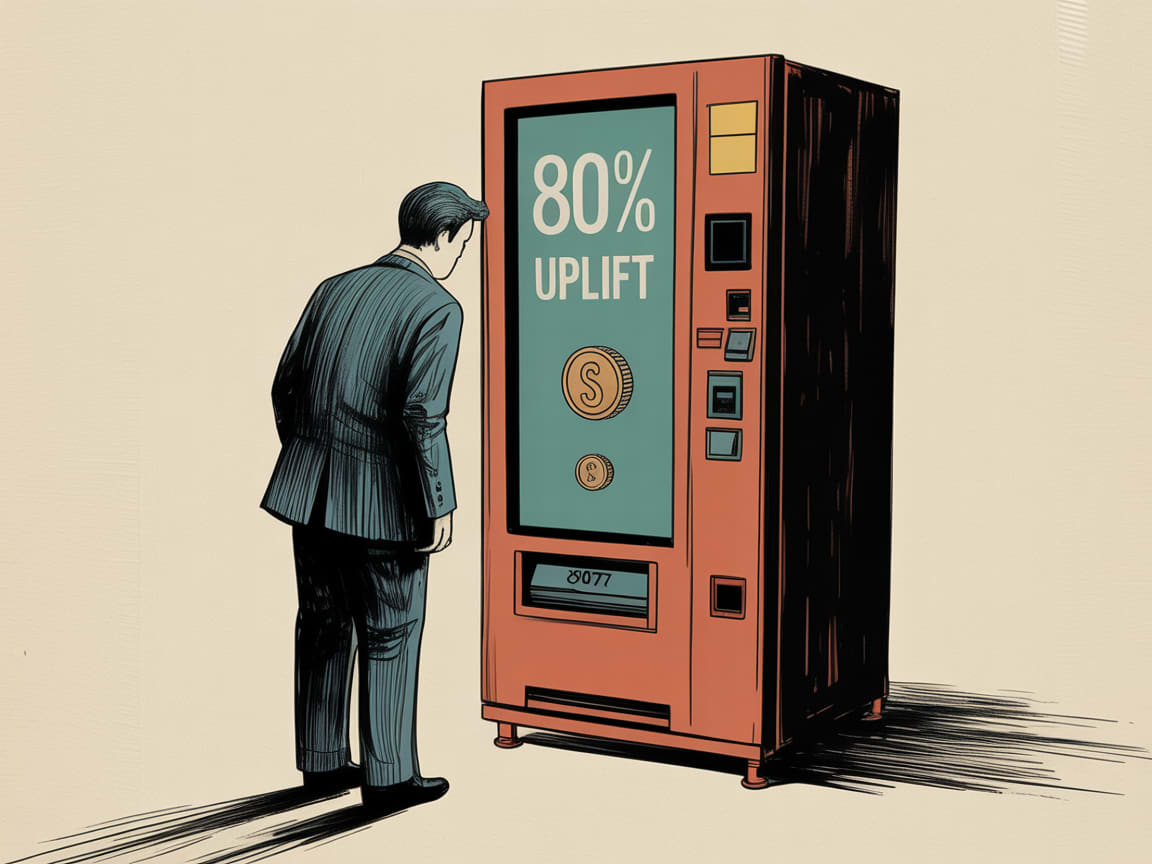
Google claims AI-powered ads lift sales by 80%. But as the programmatic supply chain frays, smart brands are asking who's actually capturing that value.
Google’s claim that its AI-powered ad products help some brands lift online sales by 80% landed predictably well at Shoptalk Spring. A number that size commands attention. But for anyone who’s spent time inside the programmatic supply chain lately, the more pressing question isn’t whether AI can generate that kind of uplift — it’s whether your infrastructure is actually positioned to capture it.
The 80% Headline Needs a Footnote
During Shoptalk Spring, Courtney Rose, VP of Retail at Google Ads, cited early results from AI-powered campaigns showing online sales lifts of up to 80% for some brands, as reported by Digiday. The qualifier “some brands” is doing a lot of work in that sentence. These numbers almost certainly reflect optimal conditions: clean first-party data inputs, well-structured product feeds, mature conversion tracking, and campaigns with enough historical signal for Google’s models to learn from.
For the majority of Southeast Asian brands — particularly those running across fragmented e-commerce surfaces like Shopee, Lazada, and TikTok Shop simultaneously — those conditions are rarely met. Conversion data is siloed by platform. First-party signals are thin or inconsistently collected. Feed quality is an afterthought. The AI is only as smart as the infrastructure feeding it, and most brand infrastructures are leaking signal at every join.
This isn’t an argument against Google’s AI ad tools. It’s an argument for getting your data house in order before expecting the headline number to apply to you.
The Supply Chain Problem Eating Your Margin
Zoom out, and there’s a harder conversation happening in parallel. AdExchanger’s recent episode with Danny Spears, COO of publisher alliance Ozone, put it plainly: the programmatic supply chain may not be fully fixable, but publishers — and by extension, advertisers — can’t afford to stop trying to fix it. Spears describes the current moment as a “perfect storm” of macro pressure, signal loss, and traffic dips creating compounding stress across the ecosystem.
The structural issue is familiar but newly urgent: intermediaries extracting value at every layer of the stack without proportionate contribution to outcomes. For advertisers in Southeast Asia, this is not an abstract problem. Regional DSPs, reseller arrangements, and murky auction dynamics mean that a significant portion of media spend never reaches a quality impression. When Google or any walled garden cites performance uplifts, those numbers are measured inside their own clean environments — not against the full complexity of a multi-network programmatic buy.
Brands that are serious about AI-driven performance gains need to first conduct a supply path audit. Which SSPs and intermediaries are sitting between your budget and your audience? Where is fee opacity highest? SPO (Supply Path Optimisation) has been an industry talking point for years, but in the current environment — where signal loss is accelerating and every dollar of efficiency matters — it’s now a baseline requirement, not a nice-to-have.
Signal Loss Is the Variable Neither Side Wants to Discuss
Here’s the uncomfortable tension in the current AI ads narrative: Google’s Performance Max and similar AI-native campaign types are most effective when they have access to robust, real-time signals. But the broader industry trajectory — privacy regulation, identifier deprecation, app tracking transparency — is systematically reducing the signal density these systems need to perform.
In Southeast Asia, this tension is particularly sharp. Mobile-first markets with high app usage mean ATT opt-out rates have real bite. Markets like Thailand and Indonesia are moving toward stronger data localisation frameworks. And the multi-platform consumer journey — someone discovering a product on TikTok, researching on Google, and purchasing on Shopee — creates attribution gaps that no single AI system can fully bridge without clean room infrastructure or strong first-party data partnerships.
Brands investing in Google’s AI ad stack without simultaneously investing in first-party data infrastructure are essentially building on a foundation that’s actively eroding. The practical implication: prioritise server-side tagging, consent-respecting CRM onboarding, and clean room setups with your key retail media partners. These aren’t long-term strategic plays anymore — they’re the price of entry for sustained AI-driven performance.
Where the Real Competitive Advantage Lives
The brands most likely to realise something close to Google’s cited uplifts share a few characteristics: they own meaningful first-party data assets, they’ve invested in feed and creative infrastructure that AI systems can actually optimise against, and they’ve simplified their supply chains enough that spend is reaching quality inventory efficiently.
For Southeast Asian brands, a regional retail media network like Lazada Sponsored Solutions or Shopee Ads can actually be an advantage here — the closed-loop attribution is cleaner than open-web programmatic, and the AI optimisation layers are improving rapidly. The risk is over-indexing on walled garden performance at the expense of building portable data assets that work across environments.
The 80% uplift story is real for someone. The question worth asking is whether you’ve built the conditions for it to be real for you — or whether you’re still funding intermediary margins and plugging signal gaps with optimism.
Key Takeaways
- Google’s AI ad uplift figures are conditional on clean data inputs and conversion infrastructure — audit your first-party data maturity before benchmarking against headline numbers.
- Supply path optimisation is no longer optional: intermediary opacity compounds with signal loss to quietly erode the ROI that AI tools are meant to generate.
- Southeast Asian brands should prioritise server-side tagging, CRM onboarding, and retail media clean room partnerships as the foundational layer for sustainable AI-driven performance.
The uncomfortable question the industry hasn’t fully answered: if AI optimisation keeps concentrating performance inside walled gardens with clean data, what happens to the open web programmatic ecosystem — and the publishers, audiences, and advertisers who depend on it? The supply chain may not be fixable. But the brands that thrive in the next three years will be the ones who stopped pretending it wasn’t broken.
At grzzly, we work with growth teams across Southeast Asia on exactly this challenge — closing the gap between what AI ad tools promise and what your current data infrastructure can actually deliver. From supply path audits to first-party data strategy, we help brands build the foundations that make the headline numbers possible. Let’s talk
Sources

Written by
Rogue GrizzlyOperating at the contested frontier of cookieless targeting, clean rooms, and identity resolution. Comfortable where the infrastructure is shifting and the playbooks have not yet been written.