
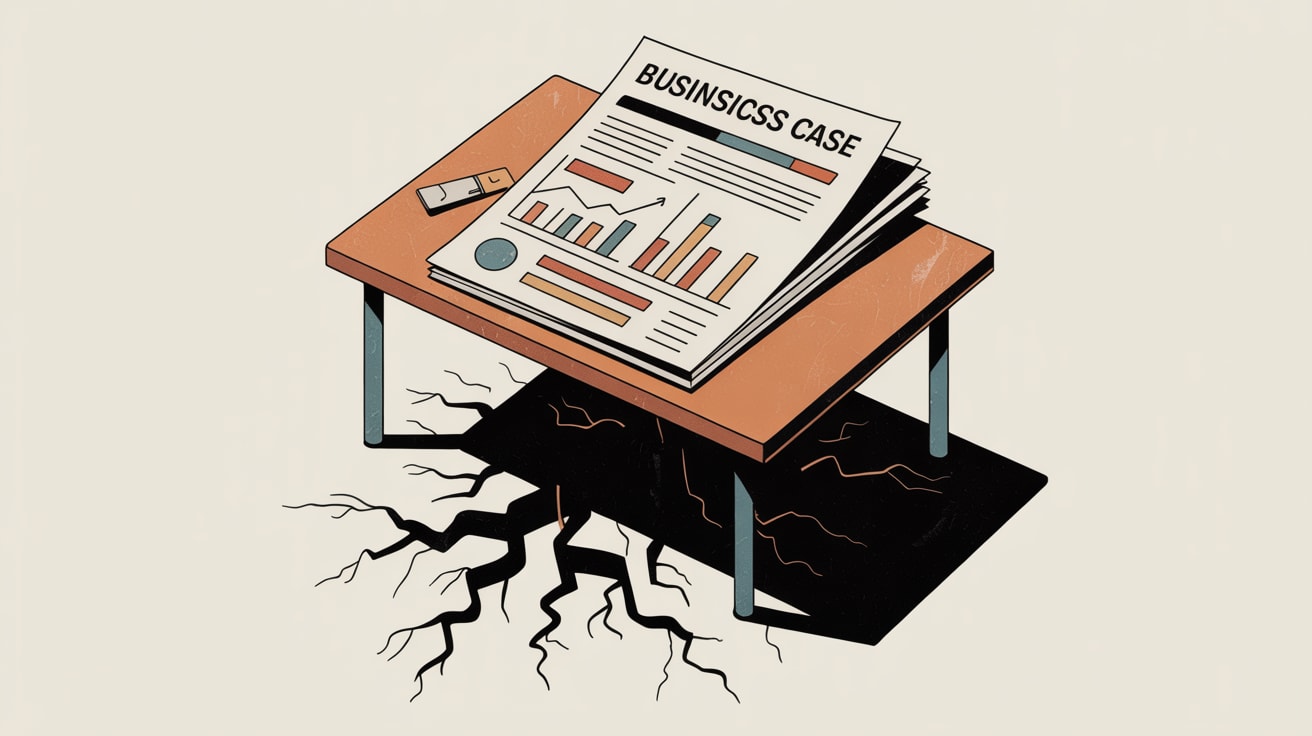
Most martech consolidation business cases collapse post-signature. Here's what the ROI models miss — and how to build one that holds up.
The consolidation pitch is always seductive: rationalise your martech stack, cut vendor overlap, reduce spend. The business case lands clean in a slide deck. Then the contract is signed, and reality starts its audit.
MarTech’s analysis of martech consolidation failures is blunt — most ROI models are structurally incomplete before the ink dries. And the same blind spots showing up in consolidation cases are now reappearing in the wave of AI workflow investment justifications. If your team is building business cases in either category right now, the timing of this conversation matters.
The Three Costs That Never Make It Into the Model
Tonya Walker’s reporting at MarTech identifies a consistent pattern in failed consolidation cases: the ROI model captures licensing savings but ignores the three costs that actually determine whether the deal creates value.
First, adoption gaps — the delta between projected utilisation and actual day-one usage by the teams who will live in the tool. A platform consolidation that assumes 80% adoption in month one, when historical onboarding data suggests 40% is realistic, is not a conservative estimate. It’s fiction with a spreadsheet attached.
Second, integration work — the engineering and data hours required to connect a new platform to existing infrastructure. In SEA markets where many brands operate across fragmented ecosystems (Shopee, LINE, Grab, proprietary loyalty stacks), integration complexity is routinely underestimated by 2–3x.
Third, renewal pricing — the rate card that applies after your introductory contract expires. Vendors who win deals on compressed initial pricing frequently recalibrate at renewal. A three-year ROI model built on year-one pricing is a liability, not an asset.
AI Workflow ROI Has the Same Structural Problem
The business case architecture for AI integration into marketing workflows is, frankly, running the same play. MarTech’s guidance on proving AI ROI in B2B contexts identifies efficiency gains and performance lifts as the standard justification metrics — and they are real. But the measurement frameworks being deployed tend to capture output volume (content produced, campaigns launched, reports generated) without adequately accounting for the cost of maintaining output quality.
Greg Kihlstrom’s analysis in MarTech is precise on this point: AI commoditises execution, which means the competitive variable shifts to judgment. Teams that flood channels with AI-generated content at scale are not winning — they are accelerating brand dilution. The ROI model that counts pieces of content produced per hour misses the cost of the strategic review layer required to keep quality defensible.
For SEA brands operating multilingual campaigns across TH, ID, VN, and PH simultaneously, this quality-control cost is not theoretical. It scales with linguistic complexity and cultural specificity in ways that generic AI output cannot absorb without human editorial oversight.
What a Credible Business Case Actually Requires
Building a martech or AI ROI model that survives contact with post-implementation reality requires three structural adjustments.
Model adoption as a ramp, not a switch. Build 60/75/90 adoption rate scenarios across a 12-month curve. The difference between a 60% and 90% utilisation assumption over 24 months can swing projected ROI by 30–40% on mid-market platform investments. Show stakeholders the range, not the optimistic single point.
Make integration costs a named line item. Estimate engineering hours, data pipeline work, and QA cycles explicitly — then apply a 1.5x buffer. If your organisation has a track record of integration projects running over, use your own historical multiplier. Presenting a range of $40K–$80K integration cost is more credible than presenting $0 and discovering $60K mid-project.
Stress-test against renewal pricing. Request the vendor’s standard renewal rate card before signing. Build the year-three cost scenario into your base case, not your risk scenario. If the deal only works on introductory pricing, the deal does not work.
The Judgment Layer Is a Budget Line, Not a Bonus
The broader shift that both consolidation and AI integration cases expose is the same: as execution becomes cheaper and faster, the strategic and quality-control layer becomes more valuable and more expensive to staff correctly.
MarTech’s framing — that AI elevates judgment as it commoditises execution — is accurate, but it carries an implementation implication that business cases are not yet reflecting. Judgment is not free. Senior strategists, editorial oversight, data quality governance, and identity resolution expertise (particularly relevant as cookieless infrastructure matures across SEA’s fragmented consent environments) are costs that belong in the numerator of your ROI model, not as assumptions buried in a footnote.
The brands that will extract durable value from this wave of martech and AI investment are not the ones who approved the largest budgets. They are the ones who built honest models, held vendors accountable to realistic integration commitments, and invested in the human layer that gives automated execution its quality ceiling.
The question worth sitting with: if your current business case only works under optimistic assumptions, what does that tell you about the decision you are actually making?
At grzzly, we work with growth and marketing ops teams across SEA who are navigating exactly these tradeoffs — building stack strategies that hold up at renewal, not just at signature, and AI integration frameworks that account for the quality and governance layers that generic playbooks ignore. If your team is mid-consolidation or building an AI ROI case and the model is starting to feel optimistic, Let’s talk.

Sources

Written by
Rogue GrizzlyOperating at the contested frontier of cookieless targeting, clean rooms, and identity resolution. Comfortable where the infrastructure is shifting and the playbooks have not yet been written.