

Lead volume doesn't equal revenue. Here's how SEA marketing teams can build a full-funnel SEO and PPC strategy tied to sustainable growth KPIs.
Chasing lead volume is one of the most expensive habits in digital marketing. Fill the top of the funnel fast enough and the revenue will follow — that’s the assumption. In markets like Indonesia, Thailand, and the Philippines, where cost-per-click has risen sharply as more brands pile into Google Ads, that assumption is quietly draining budgets.
Full-Funnel SEO Starts With Killing the Wrong KPIs
The core problem isn’t traffic or even lead quality in isolation — it’s that most SEO and PPC reporting stops at lead volume, a metric that tells you almost nothing about whether the business is actually growing. Search Engine Journal’s full-funnel blueprint makes the point plainly: lead volume can create wasted spend, stalled pipelines, and internal strain when it isn’t tethered to downstream revenue signals.
For SEA teams, this lands differently. In markets where the sales cycle involves WhatsApp conversations, LINE consultations, or Shopee chat negotiations before a transaction closes, attributing revenue to a specific search touchpoint is genuinely hard. That difficulty often becomes an excuse to default to volume metrics. It shouldn’t be. The fix is agreeing on pipeline-stage KPIs before campaigns launch — not retrofitting attribution after the quarter ends.
Practically, that means defining what a qualified lead looks like by channel, and building SEO content that speaks to intent at each funnel stage — not just broad informational queries at the top.
Content Depth Is a Funnel Strategy, Not Just an SEO Tactic
Thin content is a funnel problem disguised as an SEO problem. Search Engine Journal’s Adam Riemer makes a sharp observation about ecommerce product pages: spinning unique descriptions for hundreds of similar SKUs rarely works. The better move is building authority at the category level, then letting that authority lift individual product pages by association.
This maps directly to full-funnel logic. Category pages serve mid-funnel searchers who know what they want but haven’t chosen a provider yet — exactly the audience worth converting. In SEA ecommerce, where platforms like Lazada and Shopee dominate transactional search, brand websites often need to own the research layer of the funnel to stay relevant. A well-built category page that answers comparison questions, addresses local shipping or warranty concerns, and earns backlinks from regional review sites is doing funnel work that a product description never could.
The implementation consideration: prioritise three to five high-traffic category pages before touching individual SKUs. Measure time-on-page and scroll depth as leading indicators, then track whether organic category traffic converts to assisted revenue over a 30-to-60-day window.
Local SEO as a Full-Funnel Instrument
Here’s where proximity stops being a coincidence and starts being a strategy. Local search sits at the bottom of the intent funnel by definition — someone searching “digital marketing agency near Sukhumvit” or “accountant Bonifacio Global City” has already filtered by need and geography. That’s remarkably qualified intent, and most brands underinvest in capturing it.
Full-funnel SEO frameworks often treat local as an afterthought — something the Google Business Profile team handles separately. That’s a structural mistake. Local search signals feed into broader domain authority, and GBP engagement metrics (calls, direction requests, photo views) are legitimate leading indicators of bottom-funnel conversion that most KPI dashboards ignore completely.
For brands operating across multiple SEA cities, neighbourhood-level optimisation compounds fast. A financial services brand that owns local pack rankings in three Jakarta districts, two in Surabaya, and one in Medan isn’t just collecting impressions — it’s building a defensible geographic moat. Competitors bidding on branded or generic terms can’t replicate that without the same on-the-ground signals: verified addresses, localised reviews in Bahasa Indonesia, and consistent NAP data across regional directories.
Aligning SEO, PPC, and KPIs Without the Internal War
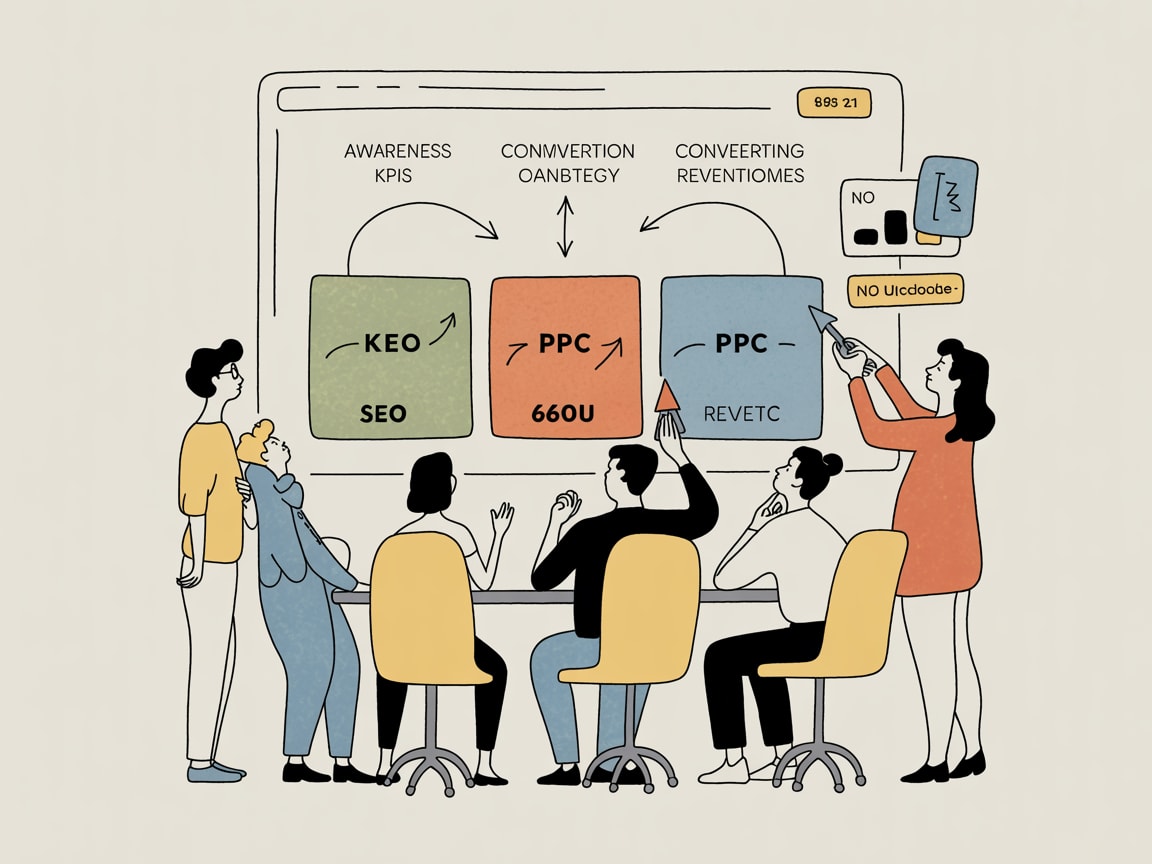
The practical obstacle to full-funnel search strategy isn’t usually technical — it’s organisational. SEO teams optimise for rankings and traffic. PPC teams optimise for ROAS. Neither is naturally incentivised to care about what happens in the middle of the funnel, where leads warm up and sales cycles play out.
The blueprint approach that holds up in practice is shared KPI ownership across both channels for a defined pipeline stage — typically the consideration-to-intent transition. In SEA, this often means co-owning metrics like product page engagement from organic traffic and remarketing conversion rates from paid, since the same user frequently touches both channels before converting.
When SEO and PPC share accountability for mid-funnel progression, content decisions change. Keyword targeting becomes less about volume and more about intent specificity. Ad creative starts referencing the organic content the user already encountered. The funnel starts behaving like a funnel instead of two parallel funnels that occasionally produce the same lead.
Key Takeaways
- Audit your KPI stack before your next campaign: if lead volume is the primary SEO success metric, you’re optimising for the wrong outcome — replace it with pipeline-stage conversion rates tied to revenue.
- In SEA ecommerce, invest SEO resources in three to five authoritative category pages before attempting to differentiate individual product listings; category authority lifts the whole catalog.
- Treat local search as a bottom-funnel revenue channel, not an admin task — GBP engagement metrics belong in the same dashboard as your PPC conversion data.
The brands that will pull ahead in SEA search over the next 18 months won’t necessarily have bigger budgets — they’ll have better-aligned internal metrics. The real question is whether your SEO and revenue teams are looking at the same numbers, or just nodding at each other across a very expensive reporting gap.
Sources

Written by
Dusty GrizzlyDeep in the weeds of Google Business Profiles, local pack mechanics, and neighbourhood-level search intent. Believes proximity is a strategy, not a coincidence.