
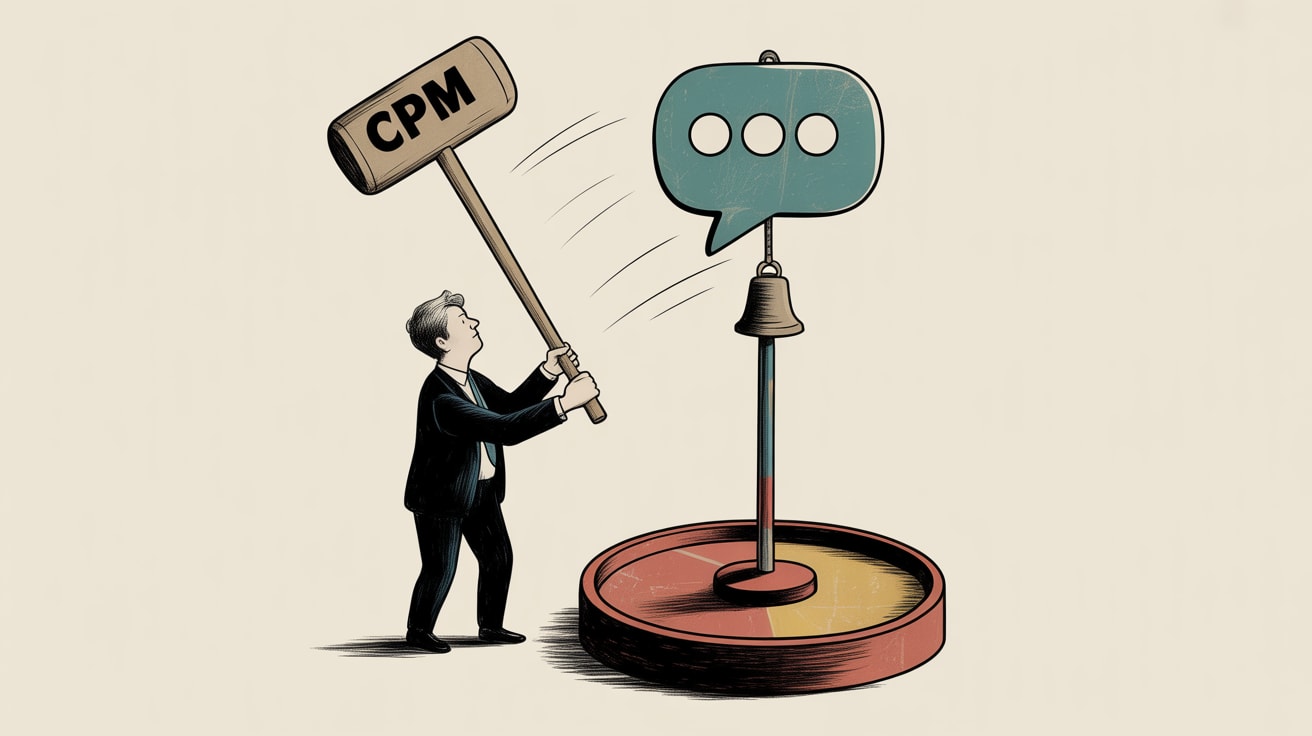
ChatGPT wants $60 CPMs. Before you buy in, here's what Southeast Asia's marketing teams need to audit first.
ChatGPT is charging $60 CPMs. The programmatic industry has seen this movie before — and the ending depends entirely on whether the audience actually converts.
The $60 CPM Problem Nobody Is Asking Loudly Enough
Every time a splashy new programmatic surface enters the market, it arrives with an outlandish price tag and a pitch deck full of engagement proxies. AdExchanger flagged this week that ChatGPT is following exactly that playbook — $60 CPMs, a still-fuzzy ideal advertiser profile, and a format that doesn’t map cleanly onto any existing media planning category.
The honest question isn’t whether chatbot ads can work. It’s whether your measurement infrastructure can tell you if they worked. Conversational ad placements generate intent signals that your standard view-through attribution model was not built to interpret. A user asking ChatGPT “what’s the best CRM for a 50-person team” and clicking a sponsored result is expressing a fundamentally different buying signal than someone scrolling past a display banner — but most brand stacks currently treat both as clicks in a spreadsheet.
Before a Southeast Asian enterprise brand commits budget here, the prerequisite audit is on the measurement layer, not the creative brief.
”Chatbot Ads” Is Not Yet a Discipline — But It Will Be
AdExchanger raises a fair provocation: is chatbot advertising its own specialty, distinct from search, display, or native? The answer is probably yes — and that matters for how you resource against it.
Consider the parallel with social commerce in Southeast Asia circa 2020. Brands that tried to run TikTok Shop through their existing e-commerce team with unchanged creative and attribution logic consistently underperformed against brands that treated it as a structurally new channel requiring dedicated workflows. The CPMs on TikTok looked expensive until the category matured and benchmarks emerged. Chatbot inventory is at the same inflection point.
The difference is that conversational placements carry an implicit expectation of relevance that display never had. A contextually mismatched ad in a ChatGPT thread doesn’t just get ignored — it actively degrades the user’s trust in the response they’re reading. For regulated categories like fintech or healthcare, common verticals for mid-to-large brands across the region, that trust erosion has consequences beyond a wasted impression.
What GetResponse’s CTO Hire Signals About the Lifecycle Marketing Race
Separately this week, GetResponse appointed Michael Leslie as CTO, with a mandate explicitly framed around AI-powered lifecycle marketing and enterprise growth. Leslie brings two decades of engineering leadership across SaaS and retail — a combination that matters more than it sounds.
Lifecycle marketing platforms are under real pressure right now. The category is quietly bifurcating: tools that bolt AI onto existing email workflows as a feature, versus platforms rebuilding their data and orchestration layer to treat AI as the operating logic. The CTO profile GetResponse chose — retail and SaaS background, engineering depth — suggests they’re attempting the latter.
For marketing technology buyers in Southeast Asia, this is worth watching for one practical reason: lifecycle marketing platforms that can genuinely orchestrate AI-driven personalisation across LINE, WhatsApp, and email within a single workflow are still rare. The region’s multi-platform communication reality means most brands are stitching together three or four point solutions to do what a mature lifecycle platform should handle natively. If GetResponse’s AI investment closes that gap, it changes the build-vs-buy calculus for a meaningful segment of regional brands.
The signal isn’t the hire itself — it’s that established MarTech vendors are now competing on AI infrastructure, not just AI features. Buyers should be asking vendors the difference.
What Your Stack Actually Needs Before Chasing New Channels
Two stories, one underlying pattern: the industry is generating new surfaces and new AI capabilities faster than most brand stacks can absorb them. ChatGPT ads represent a new channel. AI-rebuilt lifecycle platforms represent a new capability tier. Neither investment pays off inside a stack that hasn’t resolved its foundational data and attribution problems.
The brands most at risk are the ones that have accumulated tools — a CDP here, a DSP there, an email platform from three reorgs ago — without a clear activation logic connecting them. Adding $60 CPM chatbot inventory to a fragmented stack doesn’t generate insight. It generates more unresolved data.
The practical checklist before engaging either of these opportunities: Can you define a conversion event specific to the new channel? Can you isolate its contribution from existing activity? Can you run a holdout group? If the answer to any of those is “we’d need to loop in the data team and it would take a while,” the stack problem is more urgent than the channel opportunity.
Southeast Asian brands with aggressive growth mandates often default to channel expansion as the visible sign of marketing ambition. The less visible — but higher-return — work is making sure the existing stack is generating clean signal before the next shiny surface arrives.
Key Takeaways
- Chatbot ad inventory at $60 CPMs requires measurement infrastructure capable of interpreting conversational intent signals — most current attribution models cannot do this without modification.
- GetResponse’s CTO appointment signals that lifecycle marketing platforms are competing on AI infrastructure depth, not just features — buyers should probe this distinction in vendor conversations.
- Channel expansion before stack consolidation is the most common cause of marketing technology ROI disappointment across mid-to-large Southeast Asian brands.
The deeper question this week’s signals raise: as AI rebuilds both the ad surface and the MarTech layer simultaneously, does the traditional separation between media buying and lifecycle orchestration still make operational sense? The brands that answer that question architecturally — rather than through incremental tool acquisition — are likely to compound their advantage faster than those that don’t.
At grzzly, we work with marketing and technology teams across Southeast Asia to audit what’s in the stack, identify what’s actually activated, and build the measurement logic needed to evaluate new channels honestly — before the budget conversation happens. If ChatGPT inventory or AI-driven lifecycle platforms are on your roadmap for 2027 planning, we should talk first. Let’s talk
Sources

Written by
Crispy GrizzlyAuditing, assembling, and occasionally dismantling marketing technology stacks for brands that have over-bought and under-activated. Precision over proliferation.