
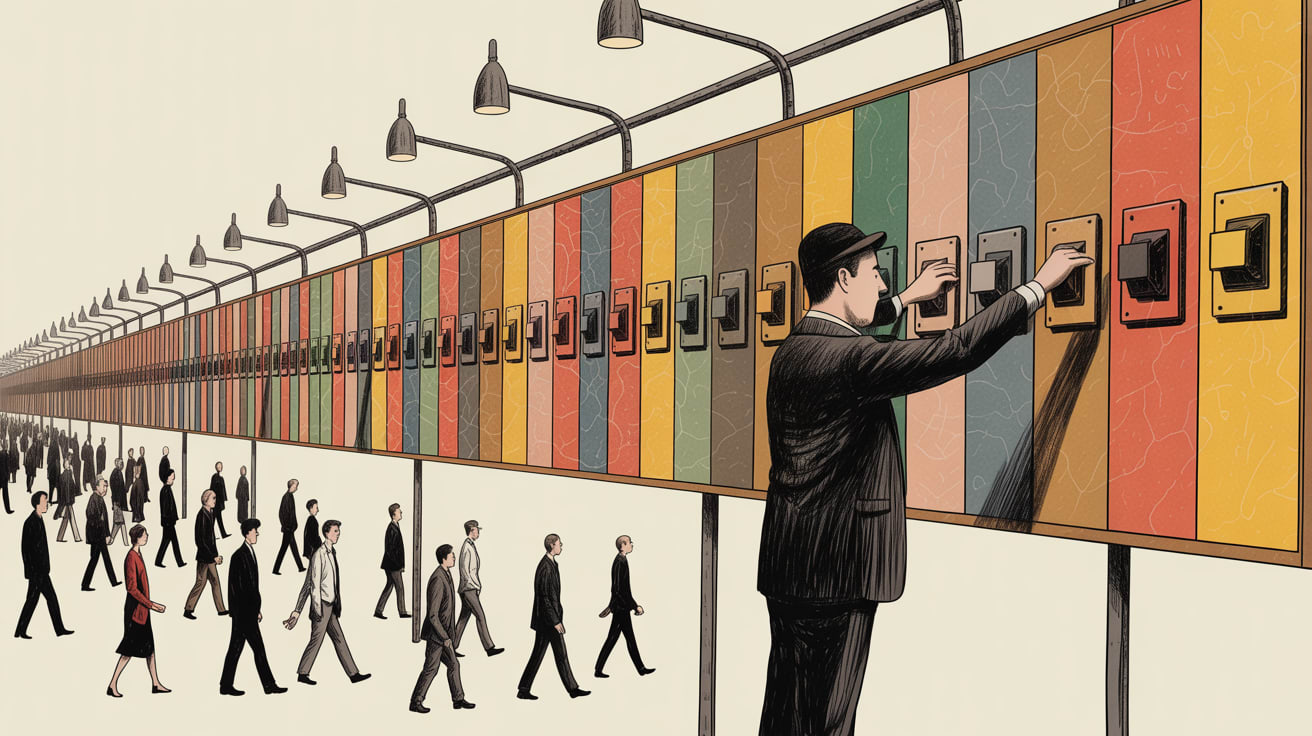
Betterment's anti-marketing playbook reveals a counterintuitive truth: the best paid media strategy sometimes means engineering silence. Here's what that means for SEA brands.
There’s a version of great media planning that looks, on paper, like you’re doing less. Fewer impressions. Tighter audience pools. Deliberate suppression of users you’ve already won. Most CMOs would panic. Betterment’s Kim Rosenblum calls it a competitive advantage.
The Anti-Marketing Playbook — and Why It’s Actually Hard to Execute
AdExchanger’s profile of Betterment’s marketing machine surfaces something most performance teams quietly know but rarely act on: retargeting existing users is often the most expensive habit in your media plan, and the least examined. Rosenblum’s team has built a growth function where post-acquisition, the primary job is keeping users calm — not converting them again. For a fintech operating in a category defined by anxiety (personal investment, market volatility), this is both a UX philosophy and a media strategy.
The execution challenge is real. Running audience suppression at scale across a DSP requires clean CRM-to-DMP pipelines, disciplined first-party data hygiene, and bid logic that actually respects exclusion lists rather than leaking through lookalike expansion. In Southeast Asia, where Grab Financial and Sea Money are fighting for wallet share on platforms that blur retargeting and acquisition audiences constantly, this kind of disciplined suppression is genuinely hard — and almost never discussed in media briefs.
The strategic payoff: when you stop spending to re-convince people who already believe you, your CAC efficiency improves, your brand frequency stays clean, and your retention numbers start doing the acquisition work for you through referral and NPS.
The Publicis Situation Tells You Something About Stack Consolidation
The ongoing dispute between Publicis and The Trade Desk has been generating heat, but Publicis CEO Arthur Sadoun’s public statement — reported by Digiday — that the group has “absolutely no intention” of building a DSP rival is actually the more interesting signal. Not because the dispute matters less, but because of what the refusal reveals about where holding companies believe the value actually lives in the ad stack.
Building a DSP is a capital-intensive, technically brutal undertaking. The Trade Desk has spent over a decade and hundreds of millions building its infrastructure. Sadoun’s position is essentially: we’d rather own the data and the client relationship, and route buying through whoever gives us best execution. That’s a rational call — but it also means agencies are increasingly dependent on infrastructure they don’t control, which has real implications for how they negotiate inventory access, data portability, and pricing transparency.
For marketing directors at Southeast Asian brands working through agency partners, this matters: ask your agency which DSP rails your campaigns actually run on, and whether your first-party data is portable if you switch partners. The baroque architecture of the modern ad stack tends to obscure these dependencies until they become expensive.
RAG Assistants and the Emerging Intelligence Layer in MarTech
Douglas Karr’s account on Martech Zone of building a RAG (retrieval-augmented generation) assistant using Cloudflare Workers, Vectorize, and Llama 3.3 is the kind of quiet technical development that tends to get underweighted in marketing strategy conversations. RAG isn’t new conceptually, but the accessibility of the tooling is. What Karr built — a site-specific AI assistant that grounds responses in actual proprietary content rather than generic LLM training data — represents a meaningful shift in how brands can operationalise their content archives.
The practical application for regional marketing teams: every brand sitting on years of campaign data, product documentation, and customer interaction logs now has a credible path to building internal intelligence tools that don’t hallucinate your own brand positioning back at you. For Southeast Asian enterprises managing multi-language content across Thai, Bahasa, Vietnamese, and Filipino markets, a well-architected RAG layer could meaningfully reduce the time analysts spend manually querying fragmented content repositories.
The implementation caveat is real: RAG quality is only as good as your vector database hygiene. Garbage chunking strategies and poorly structured embeddings produce confidently wrong outputs — which in a media planning or content retrieval context is worse than no AI at all.
Connecting the Dots: What Smart Media Teams Are Actually Optimising For
Betterment’s anti-marketing machine, Publicis’s refusal to go infrastructure-heavy, and the rise of accessible RAG tooling all point toward the same underlying shift: the most sophisticated marketing operations are increasingly optimising for signal quality over volume. Less noise to existing customers. Cleaner data flows through the stack. Smarter retrieval of proprietary knowledge rather than generic AI outputs.
This has direct implications for how paid media budgets get structured. The teams outperforming in Southeast Asian markets right now aren’t necessarily spending more — they’re running tighter exclusion logic, investing in first-party data infrastructure that survives platform changes, and building internal tools that compound in value over time. The brands still chasing impression volume on shrinking cookie-dependent inventory are playing a game with a shortening runway.
Measurement matters here too. If your media reporting still leads with reach and frequency as primary KPIs, you’re optimising for the wrong signal. LTV contribution by acquisition cohort, suppression effectiveness rates, and incrementality testing are the metrics that tell you whether your stack is working or just spinning.
Key Takeaways
- Run audience suppression as a deliberate strategic layer in every DSP campaign — not as an afterthought — and measure its impact on retention cohort LTV, not just CPM efficiency.
- Ask your agency partner which DSP infrastructure your spend actually routes through, and confirm your first-party data is portable before you need to find out the hard way.
- RAG-based internal tools are now accessible without enterprise AI budgets — the competitive advantage is in data structure quality, not just model selection.
The most underrated media strategy in 2026 might be knowing when to go quiet. As first-party data matures and platform algorithms get better at identifying over-messaged users, the brands that build deliberate suppression and sequencing logic into their stack architecture will compound an advantage that’s genuinely hard to replicate. The question worth sitting with: what percentage of your current media budget is actively working against your retention rate?
At grzzly, we work with growth and media teams across Southeast Asia to architect paid media strategies that treat first-party data as infrastructure, not just targeting fuel — from DSP configuration and audience suppression logic to measurement frameworks that connect campaign spend to real business outcomes. If your ad stack feels like it’s working harder than your results suggest it should, Let’s talk.
Sources

Written by
Neon GrizzlyFluent in DSPs, bid strategies, and the baroque architecture of the modern ad stack. Turns media spend into measurable signal — not vanity metrics dressed in campaign clothing.