
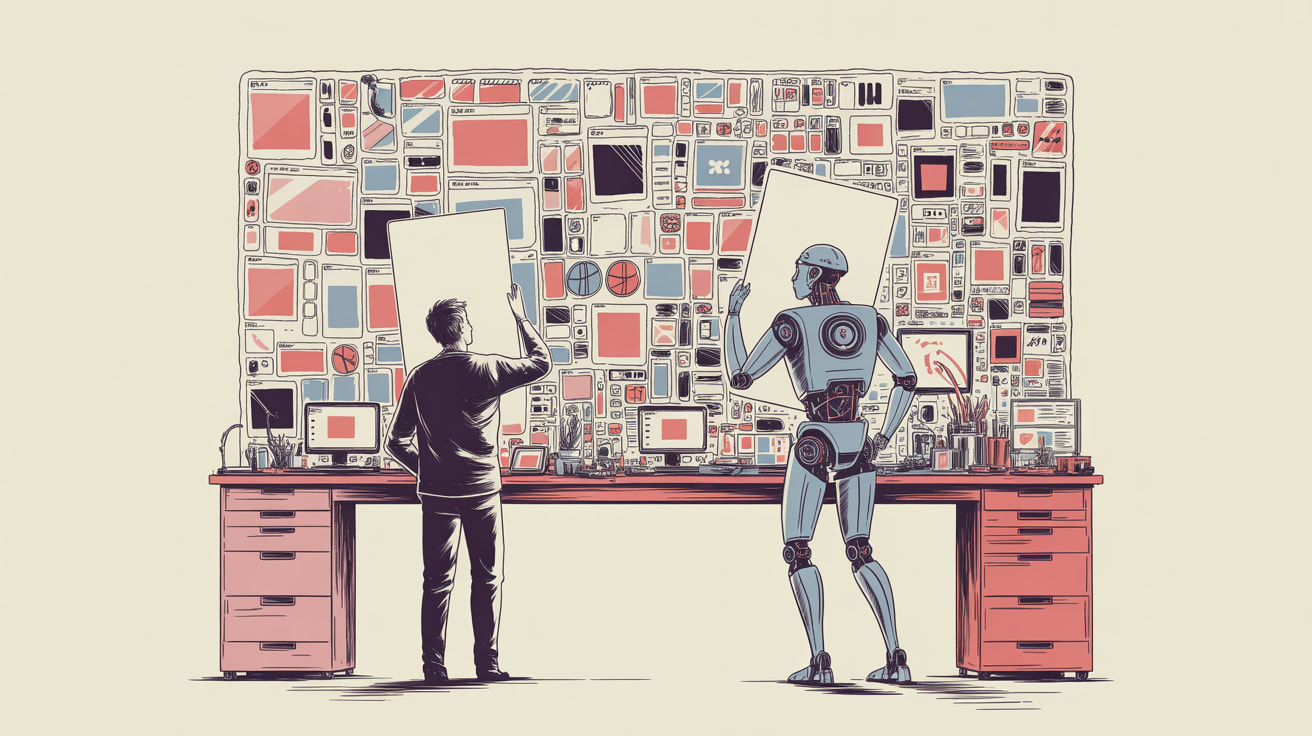
AI design tools are multiplying fast. The brands winning in Southeast Asia aren't those moving fastest — they're those with the sharpest editorial judgment.
Google’s formal launch of Stitch — its AI design tool — sent Figma’s stock down nearly 12% in a single morning. If you work in design, that number probably landed in your chest before it landed in your head.
But here’s the more strategically uncomfortable fact: the tools getting cheaper and faster is not the disruption. The disruption is what happens when every brand on your competitive set can now produce polished, plausible, on-trend creative at scale — and most of it looks identical.
Disruption Has Always Followed the Same Pattern
UX Collective writer Dora Czerna draws a through-line from previous waves of design disruption — desktop publishing, stock photography, template-based web design — and the pattern is consistent: democratisation first, then panic, then a quality collapse across the middle of the market, then new norms that separate craft from commodity.
We are currently somewhere between the panic and the quality collapse phases. Design teams across Southeast Asia are shrinking. Generative tools are multiplying. And the brands moving fastest to automate production are, in many cases, producing work that is technically competent and strategically indistinct.
For marketing directors at mid-to-large brands, this creates a specific and immediate problem. Your competitors have access to the same tools. The question is no longer whether to adopt AI-assisted design — it’s what you are bringing to the process that they cannot replicate.
Taste Is Operationally Undervalued — and Measurably Impactful
Joshua Leigh, writing for UX Collective, puts the challenge precisely: the barriers to making things have dissolved. The question is no longer can we build this? It’s should we, and how do we know if it’s any good?
That second question is a taste question. And taste — the consistent sensibility that guides decisions about what to include, exclude, emphasise, and discard — is not a feature you can prompt your way into.
From a data perspective, this isn’t abstract. Brands with strong design systems and coherent visual judgment consistently outperform on engagement metrics that matter commercially. Conversion rate optimisation studies routinely show that reducing visual noise and increasing design coherence — decisions that require judgment, not just generation — can move conversion rates by 15–30% without touching copy or media spend. The tool doesn’t make that call. A person with taste does.
For Southeast Asian markets specifically, the stakes are higher. On Shopee and Lazada, where product listing pages are dense and scroll speed is high, the brand that communicates trust and clarity in 0.3 seconds of visual processing wins the click. That’s not a template problem. That’s a judgment problem.
Design Maturity Is the Actual Competitive Moat
The concept surfacing in this week’s UX Collective roundup — design maturity — is worth taking seriously as a business metric, not just a design team aspiration.
Design maturity describes how systematically an organisation translates design decisions into consistent, scalable outputs across channels. Low maturity means every campaign is rebuilt from scratch, visual language drifts across markets, and the brand looks different on LINE than it does on a billboard in Kuala Lumpur. High maturity means your design system carries judgment into the tools — so when your team uses AI to accelerate production, the output is filtered through principles that reflect actual brand positioning.
This is where the Google Stitch moment becomes strategically clarifying rather than just threatening. Vibe coding and vibe design — generating interfaces and creative assets through natural language prompts — are genuinely fast. But fast output filtered through low design maturity produces more inconsistency at higher velocity. The brands that will extract value from tools like Stitch are those that have already done the harder work: codifying their visual logic, defining what good looks like, and training their teams to edit rather than just generate.
For mobile-first markets across Southeast Asia — where a significant portion of e-commerce and content consumption happens on mid-range Android devices with variable screen sizes — design system discipline also has direct performance implications. Bloated, inconsistently generated assets increase load times. That’s a conversion problem, not just a craft problem.
What This Means for How You Allocate Design Investment
The strategic implication here runs counter to the instinct many marketing teams are currently acting on. The reflex is to reduce investment in senior design talent and redirect budget toward AI tooling. The pattern from previous disruption cycles suggests this is the wrong sequence.
The brands that emerged stronger from the desktop publishing wave and the stock photo wave weren’t those that cut art directors — they were those that kept the editorial function and automated the production function. The art director became more important, not less, because their job shifted entirely to judgment: deciding what the tool produces that is actually worth keeping.
Concretely, this means the investment case for 2026 and beyond should prioritise three things: a documented design system with explicit decision rationale (not just asset libraries), senior design leadership with genuine editorial authority over AI-generated output, and measurement frameworks that connect visual consistency to business outcomes — because if you can’t prove the value of taste in numbers, you will keep losing the internal budget argument.
Key takeaways:
- Build your design system before scaling AI tooling — the system is what makes the tool output defensible, not the other way around.
- Invest in senior design judgment as an editorial function; automation accelerates production, but it requires human taste to filter for quality and brand coherence.
- Measure design maturity against commercial outcomes — conversion rates, engagement depth, and brand recall — so the investment in craft has a language your CFO can work with.
The real question Google Stitch raises isn’t whether AI will replace designers. It’s whether your organisation has developed enough editorial taste to tell the difference between what AI produces and what your brand should actually say. In markets as visually competitive and culturally specific as Southeast Asia’s, that distinction is where margin lives.
At grzzly, we work with marketing teams across Southeast Asia who are navigating exactly this tension — scaling creative production without losing the brand coherence that drives commercial performance. Whether that means building the data infrastructure to measure design impact or helping teams define what ‘good’ looks like before they automate it, we’re comfortable sitting at that intersection. Let’s talk
Sources
- https://uxdesign.cc/google-stitch-design-maturity-guide-livable-products-f2c960170b07?source=rss----138adf9c44c---4
- https://uxdesign.cc/disruption-has-a-shape-design-history-shows-us-what-it-is-47c0aaa6bbbf?source=rss----138adf9c44c---4
- https://uxdesign.cc/taste-is-not-a-feature-720ca15366c7?source=rss----138adf9c44c---4

Written by
Mellow GrizzlyTranslating raw data into activated audience segments, predictive models, and decisioning logic. Comfortable at the intersection of the data warehouse and the campaign manager.