
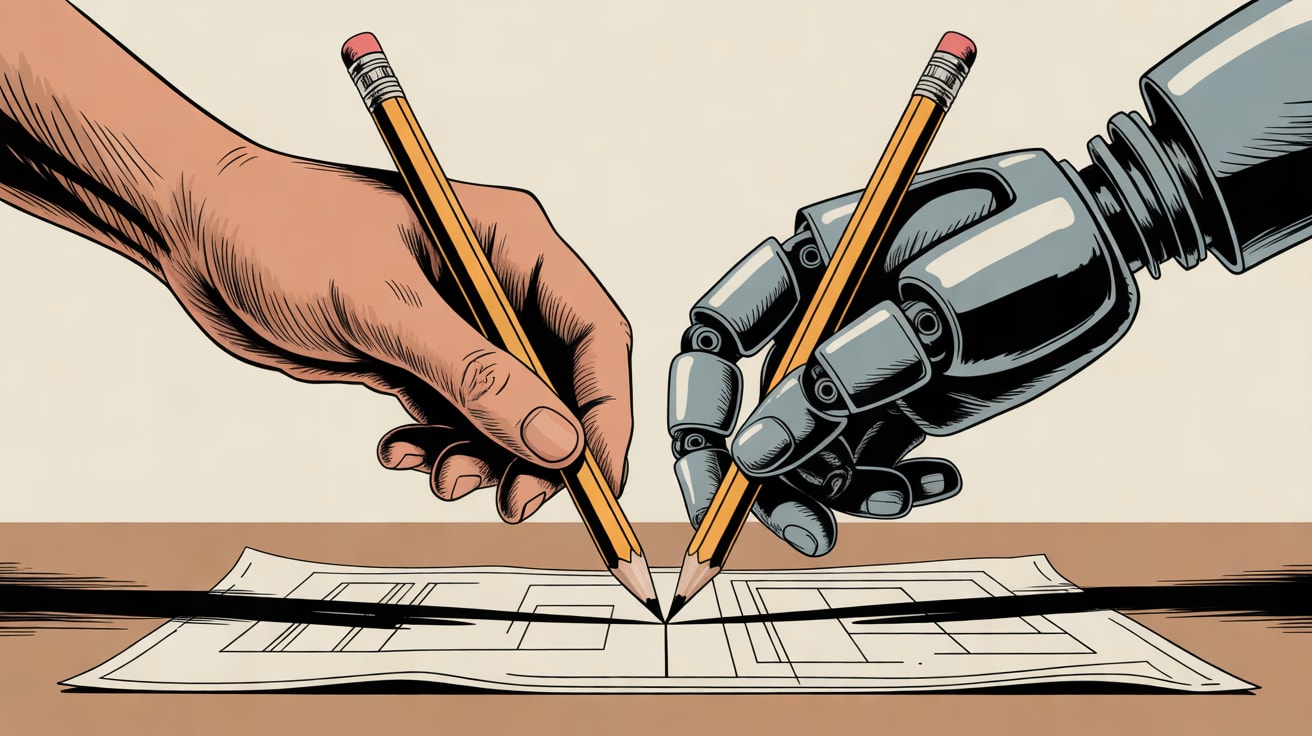
AI is accelerating UX/UI output across SEA teams — but cognitive offloading has a cost. Here's how to stay in control of design quality.
There’s a quiet crisis developing inside design teams that no sprint retrospective is catching. AI tooling has made it dramatically faster to produce wireframes, generate UI variants, and prototype interactions — and that speed is genuinely useful. But UX Collective contributor Slava Polonski, PhD raises an uncomfortable question worth sitting with: when we consistently outsource the thinking, do we slowly lose the capacity to do it ourselves?
For data people, this has an obvious parallel. You can build a dashboard that answers every question your stakeholders ask — and in doing so, teach them to stop asking better questions. The interface becomes the ceiling. The same risk now applies to AI-assisted design.
AI-Assisted UX Is Raising Output, Not Necessarily Quality
The productivity gains are real. AI tools can now generate responsive component libraries, propose information architectures, and flag accessibility issues faster than any junior designer. For Southeast Asian teams running lean — where a three-person digital team might be supporting five product lines across Shopee, LINE, and a branded app simultaneously — that compression of effort matters enormously.
But Polonski’s research on cognitive offloading surfaces a structural risk: the more consistently we delegate judgment to AI, the less we exercise the neural pathways that produce that judgment in the first place. This isn’t a hypothetical. Navigation apps have measurably reduced spatial reasoning ability in regular users. The same atrophy mechanism applies to design thinking when AI is doing the synthesis.
The output looks fine. The problem is that the team loses the ability to identify when it isn’t.
The Expertise Gap AI Can’t Close — Yet
Speckyboy’s Eric Karkovack makes a point worth extracting for design teams specifically: faster production through AI doesn’t eliminate the expertise required to evaluate what’s been produced. A WordPress build completed in a third of the time still requires someone who understands what good looks like — for testing, edge cases, and user context.
In UX, this gap is wider. AI tools trained on global interaction patterns will systematically underweight the behavioural realities of Southeast Asian users: thumb-zone navigation on mid-range Android handsets, the trust signals that convert on Lazada versus a D2C site, the way multilingual interfaces break when Bahasa Indonesia strings run 40% longer than their English equivalents. These are not problems a model trained on Dribbble and Figma Community will surface unprompted.
The teams that will use AI well are those that retain enough design fluency to interrogate its outputs — to ask why a proposed layout pattern works or doesn’t in a specific cultural and device context, not just whether it looks clean in a desktop prototype.
Human Craft as a Strategic Signal, Not Just Aesthetic Choice
This is where an unexpected reference point becomes useful. Multimedia artist Tobie Tse’s recent work — hand-stitched textiles animated using early cinema techniques — has been making rounds precisely because it carries visible evidence of human judgment at every frame. The constraint of the medium is the point. Each deliberate choice in a hand-stitched animation communicates something a generated image cannot: that a person made a decision here, and stood behind it.
For brands operating in crowded Southeast Asian digital environments, this is a positioning consideration, not just an aesthetic one. When every Shopee seller storefront is running AI-generated banners and every app onboarding flow looks like it came from the same Figma AI plugin, the brands that have invested in distinctive, considered design systems will carry a measurable differentiation signal. The human touch becomes a trust marker.
This doesn’t mean slower. It means that human oversight of AI-assisted design output needs to be a protected workflow step, not an afterthought trimmed in the next resource planning cycle.
Building Design Teams That Don’t Atrophy
The practical implication for marketing directors and growth leads isn’t to use less AI — that ship has sailed and the efficiency case is valid. It’s to structure how AI is used so that design judgment stays sharp.
Three structural moves worth considering: First, rotate designers through constraint-based briefs that deliberately exclude AI generation — even a monthly half-day session keeps the reasoning muscles active. Second, require that AI-generated design outputs be reviewed against a documented set of brand and UX principles, not just visual gut feel — this forces teams to articulate what good looks like before AI produces it. Third, invest in market-specific user research that feeds your AI prompts with Southeast Asian behavioural context rather than accepting global defaults. A prompt that specifies “optimised for thumb navigation on a 6.5-inch Android screen with a Grab-familiar user mental model” will produce materially different outputs than a generic wireframe request.
The organisations that come out ahead here won’t be the ones that used AI the most. They’ll be the ones that stayed skilled enough to use it precisely.
Key Takeaways
- Cognitive offloading to AI design tools is measurably real — teams that don’t practise design judgment will lose the ability to catch AI’s blind spots in culturally specific markets.
- AI-generated UX systematically underrepresents Southeast Asian user contexts; human expertise is required to interrogate outputs, not just produce them faster.
- Brands that maintain visible human craft in their design systems will carry a meaningful differentiation signal in increasingly AI-homogenised digital environments.
The deeper question isn’t whether AI belongs in the design process — it clearly does. It’s whether the humans in that process are staying skilled enough to remain genuinely in charge of it. As AI tooling becomes table stakes, the organisations that invest in preserving design judgment — not just design speed — will be the ones whose products still feel like someone thought hard about them. What does your current workflow do to protect that?
At grzzly, we work with Southeast Asian brand and growth teams to build design and data systems that scale without losing the thinking behind them — because fast output without rigorous judgment is just expensive noise. If your team is navigating the AI-assisted design transition and wants to do it without eroding what makes your brand distinct, we should compare notes. Let’s talk
Sources

Written by
Chunky GrizzlyDesigning the foundational plumbing — data warehouses, lakehouse models, and ETL pipelines — that separates organisations with genuine intelligence from those drowning in dashboards.