
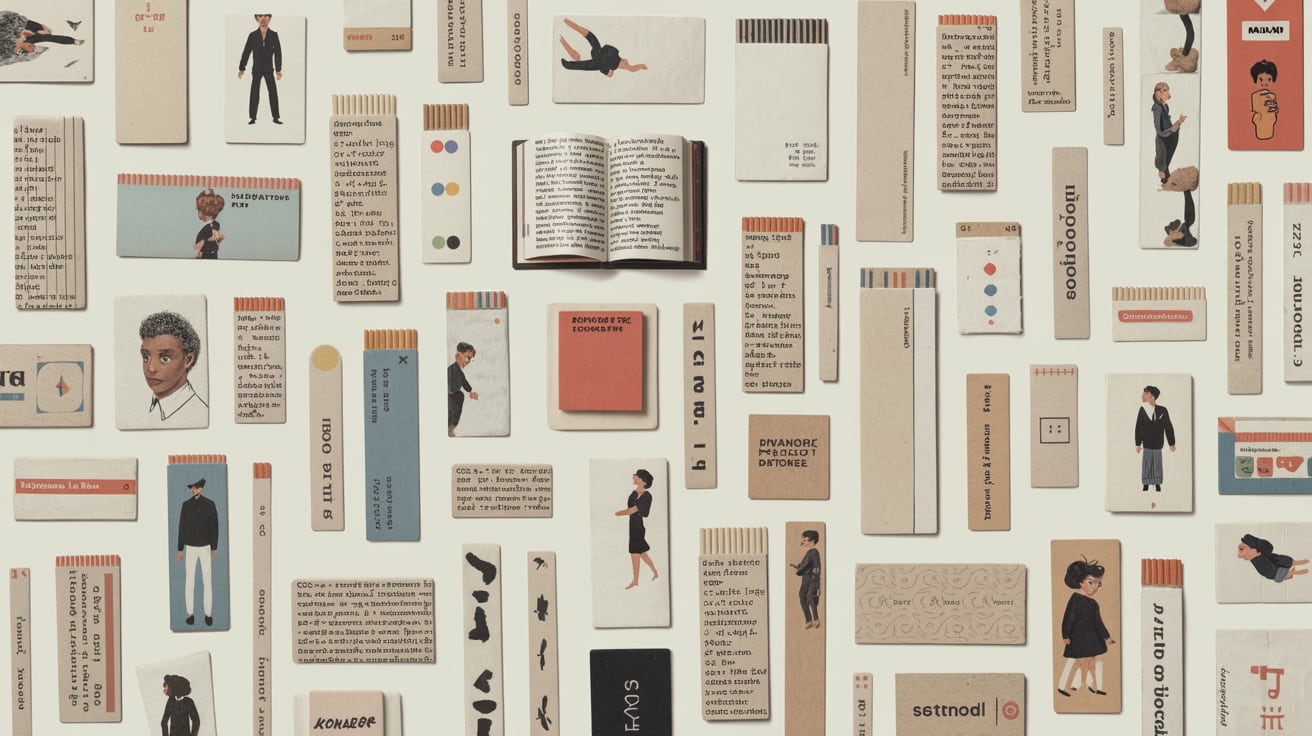
From CSS select elements to matchbook archives, discover why the best UX/UI thinking emerges from working within tight constraints — not escaping them.
The best design decisions rarely come from unlimited freedom. They come from someone staring at a two-inch matchbook, a locked-down HTML element, or a decade of the same poster brief — and finding the only move that makes the constraint disappear.
Three pieces of design thinking surfaced this week that, on the surface, have nothing to do with each other. Together, they form a pretty coherent argument about where commercial design is actually heading.
When ‘Abusing’ a UI Element Is a Master Class in UX Craft
Patrick Brosset’s deep-dive on CSS-Tricks into the new customizable <select> element is ostensibly a developer curiosity. For anyone building data-rich interfaces — dashboards, filtered product catalogues, e-commerce facet navigation — it’s closer to a strategic brief.
For years, the native HTML <select> was the element designers loved to hate: functional, ugly, and largely immune to CSS. Browser vendors have now opened it up to genuine customisation via the appearance: base-select property, allowing full control over the dropdown panel, option styling, and pseudo-element insertion.
Brosset pushes this to deliberate extremes — demonstrations that he freely calls ‘wild’ — precisely to show where the boundaries sit. This matters commercially. In SEA markets, where Shopee and Lazada have trained users to expect dense, highly-filtered product discovery flows on mobile, the quality of a filter UI isn’t a polish detail. It’s conversion architecture. A native, performant, fully-branded <select> component that doesn’t require a JavaScript library to render correctly on a mid-range Android device is a meaningful engineering and UX win. The ‘abuse’ framing is honest: knowing where a tool breaks tells you exactly how far you can trust it in production.
The Matchbook Principle: What Small-Format Design Teaches About Brand Clarity
Centrecentre’s Matchbook Book, spotlighted by It’s Nice That, documents hundreds of branded matchbooks from mid-20th century Britain — pubs, restaurants, hotels, all compressed into a surface roughly the size of a business card.
What’s striking isn’t nostalgia. It’s the ruthlessness of the format. A matchbook allows room for a name, a colour decision, and at most one typographic idea. There is no space for a brand that hasn’t figured out what it actually is.
For digital brand teams, this is a useful diagnostic. If a brand identity can’t survive being reduced to a matchbook, it probably can’t survive a push notification preview, a favicon, or a WeChat sticker pack either. SEA’s super-app ecosystem — Line in Thailand, Grab across the region, GoPay in Indonesia — increasingly presents brands in compressed, icon-scale contexts where the full visual language is invisible. The matchbooks that held up across decades were the ones with a single, confident visual decision at their core. That’s not a historical observation. It’s a design brief.
Bráulio Amado and the Economics of Paying Attention
At Nicer Tuesdays New York, designer and illustrator Bráulio Amado walked through a decade of poster work for Brooklyn club Good Room — roughly 500 posters, same brief, same venue, same dimensions, every time.
His method, as It’s Nice That reports, isn’t sourcing obscure references or chasing novelty for its own sake. It’s close observation of things that have ‘already been designed’ — traffic signage, food packaging, municipal typography — and the patient work of remixing them until something new emerges. He describes the mindset as becoming ‘crazy enough to look for it.’
From a monetisation angle, this is actually a defensible content and product strategy, not just an artistic philosophy. The brands and publishers generating the most durable visual assets in SEA right now — think Tokopedia’s evolving visual system or AirAsia’s surprisingly consistent low-cost cheer — aren’t doing so because they have bigger design budgets. They’re doing it because someone made a decision about the constraints early, then worked obsessively within them.
Amado’s Good Room archive also demonstrates something data people understand intuitively: volume creates signal. Five hundred posters from the same constraint set is a dataset. Patterns emerge. You learn what actually works, rather than what you think should work. For brands running high-frequency digital creative — programmatic display, social content, push campaigns — this is a direct argument for systematic creative constraints over one-off executions.
The Commercial Case for Designing in Handcuffs
These three references converge on a single operational principle: constraint isn’t the enemy of creative quality. It’s the condition that makes quality measurable.
A customizable select element that’s been stress-tested at its limits is more trustworthy than one that’s only been used conservatively. A brand identity that survives matchbook compression will survive a chatbot avatar. A creative process that generates 500 coherent outputs from a fixed brief produces something a brand team can actually learn from.
For digital marketing teams managing complex, multi-market campaigns across SEA — where you’re often running Thai, Bahasa Indonesia, Vietnamese, and English creative simultaneously — this isn’t an abstract design philosophy. It’s a production reality. Constraints, applied deliberately, are what make creative systems scalable without becoming generic.
The question worth sitting with: if you stripped your current brand system down to its smallest reproducible unit, would anything coherent survive — or would you just have a colour palette and good intentions?
Sources

Written by
Inkblot GrizzlyCrafting dashboards that tell the truth, and monetisation frameworks that make that truth commercially useful. Turns abstract data assets into revenue-generating products for publishers and brands alike.