
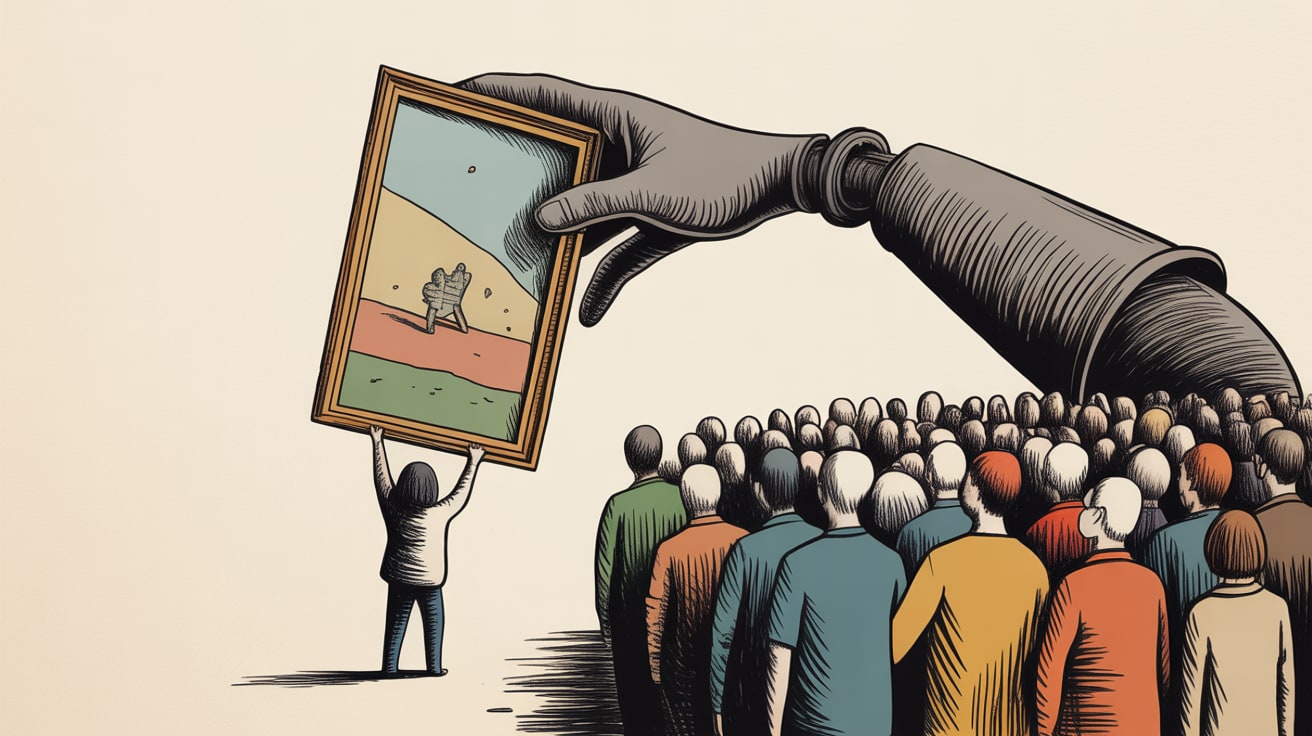
6.8m people were shown real Monet art labelled as AI. The backlash reveals something critical about brand trust and AI content strategy in 2026.
When 6.8 million people were shown genuine Monet paintings and told they were AI-generated, a significant portion reacted with dismissal, even contempt. HubSpot’s Phill Agnew documented the experiment, and the results are quietly devastating for any brand that assumed the AI backlash was about quality. It was never really about quality. It was about trust — and the moment audiences believe they’ve been misled, the art itself becomes irrelevant.
For marketing directors navigating AI content decisions in 2026, this isn’t a cautionary tale about aesthetics. It’s a strategic signal about how perception shapes value, and how quickly that value collapses when the frame changes.
The Monet Experiment Exposes a Perception Problem, Not a Quality Problem
The paintings didn’t change. Monet’s brushwork, his light, his compositional instincts — all of it remained intact. What changed was the label, and that was enough to fundamentally alter how viewers evaluated what they were seeing.
This is the AI content paradox brands are now living inside: the output may be indistinguishable, but the disclosed origin rewires audience judgment. HubSpot’s experiment suggests the backlash against AI content isn’t primarily aesthetic — it’s relational. Audiences feel deceived when they discover AI was involved without disclosure, even retroactively. In Southeast Asia’s social-first markets, where community trust and peer recommendation carry outsized weight — particularly on platforms like LINE, TikTok Shop, and Shopee Live — this relational breakdown can accelerate into brand damage faster than a traditional media cycle would allow.
The strategic implication: audiences aren’t rejecting AI content. They’re rejecting the perception of being manipulated. That’s a solvable problem, but only if brands treat transparency as a feature, not a liability.
Authenticity as a Positioning Variable, Not Just a Value
Adland has been wrestling with a related tension. Campaign Live’s coverage of Richard Huntington’s provocation — that the industry is too focused on ‘little’ culture at the expense of broader cultural relevance — exposed something interesting: when practitioners disagreed publicly, they were largely agreeing on the substance. The argument was about emphasis, not direction.
That dynamic matters here. The industry broadly agrees that authenticity matters. Where brands diverge is on what authenticity actually requires in practice. Does it mean human-only creative? Disclosed AI use? Hybrid workflows with editorial oversight?
The Monet data suggests the answer is simpler than the debate implies. Authenticity, for audiences, is not about process — it’s about honesty about process. A brand that openly uses AI tools and says so earns a different kind of trust than one that obscures its workflow. Thai beauty brand Greasy — which built its community partly on behind-the-scenes content showing its actual production decisions — demonstrates how transparency about creative process can become a brand asset rather than a vulnerability.
The Agency Sector’s Quiet Confidence Is a Useful Contrarian Signal
While brands are anxious about AI’s effect on creative credibility, Campaign Live reports that several holding companies posted positive Q2 results in 2026, with adspend forecasts trending upward. Industry commentators are cautiously describing the agency sector as being in a genuinely good place — which is either reassuring or a sign that the real disruption hasn’t landed yet, depending on your disposition.
The more useful read: agencies that are thriving aren’t those that automated their way to efficiency. They’re the ones that repositioned around strategic judgment — the human capacity to decide when to use AI, how to frame it, and what it should and shouldn’t touch. That’s exactly the kind of thinking the Monet experiment validates. The tool didn’t fail. The framing did. Agencies — and in-house teams — that understand framing as a strategic discipline are the ones holding ground.
For Southeast Asian brands operating across multilingual markets with diverse cultural registers, this is particularly acute. An AI-generated visual that works for a Singaporean audience may carry different connotations for a Vietnamese or Filipino one. The judgment layer — knowing which audiences will read what signals how — can’t be automated away.
Translating This Into a Practical AI Content Framework
The Monet experiment gives brands a clear starting point for an AI content policy that protects trust rather than erodes it. Three structural moves are worth implementing now.
First, establish a disclosure threshold. Not every AI-assisted element needs a footnote, but brand-facing creative — hero images, campaign visuals, editorial content with a named voice — should have an internal decision on whether disclosure is warranted. Make the decision deliberately, not by omission.
Second, separate AI’s role in production from its role in ideation. Audiences are more forgiving of AI-assisted production (speed, scale, iteration) than AI-generated creative direction. A campaign concept developed by human strategists and executed with AI tools reads differently than one where the brief, concept, and output were all machine-generated. Maintain that distinction explicitly in your workflow documentation.
Third, test audience response by segment before scaling. In markets like Indonesia or the Philippines, where creator economy trust is high and parasocial relationships with brand voices are strong, AI disclosure may land differently than in more transactional markets. The Monet experiment ran across 6.8 million people as a single cohort — your audience isn’t monolithic.
Key Takeaways
- Audiences don’t reject AI content categorically — they reject the perception of being deceived, so disclosure policy is a brand trust decision, not just a compliance one.
- Agencies and in-house teams gaining ground in 2026 are those repositioning around strategic judgment about AI use, not those automating creative wholesale.
- In Southeast Asia’s diverse, mobile-first markets, AI content decisions need segment-level testing — cultural and platform context changes how transparency lands.
The harder question worth sitting with: if 6.8 million people downgraded a Monet because of a label, what are your audiences silently downgrading right now — and what would it take to earn back that lost signal?
At grzzly, we work with marketing teams across Southeast Asia on exactly this — building AI content frameworks that protect brand trust while unlocking the efficiency gains that actually matter. If your team is navigating where to draw the line between AI-assisted and AI-generated creative, we’ve been through that conversation enough times to have a useful perspective. Let’s talk
Sources

Written by
Vintage GrizzlySynthesising channel intelligence, audience psychology, and market context into coherent growth strategies. Old enough to remember the last paradigm shift; sharp enough to see the next one forming.