
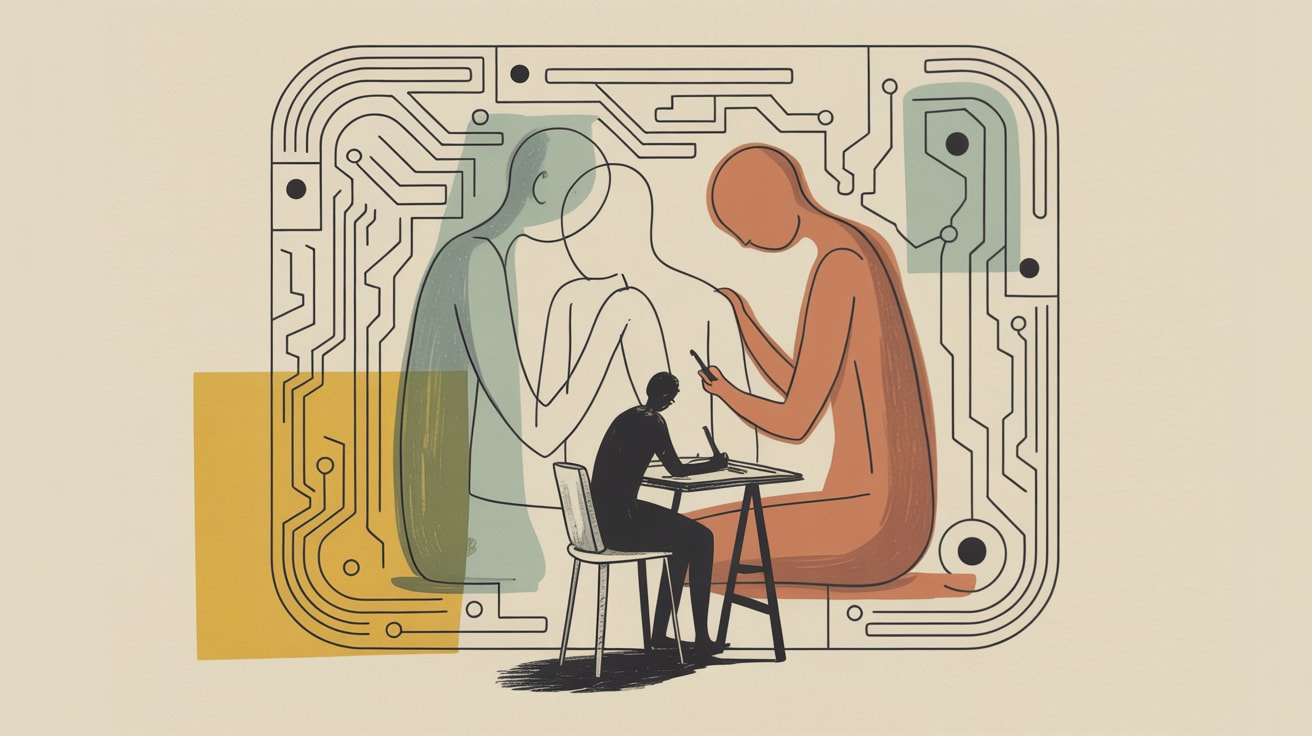
Human-centred UX design drives conversion and retention. Here's how Southeast Asian brands can measure and scale the human touch across digital products.
There’s a quiet crisis running through digital product design right now, and your analytics are probably already logging it — you just haven’t named it yet. Users are bouncing not because your information architecture is broken, but because your interface feels like it was assembled by a committee of people who’ve never actually wanted anything.
The signal is in the data if you know where to look: session recordings full of hesitation loops, heatmaps that show users orbiting a CTA without clicking, NPS scores that flatline despite a technically flawless experience. The plumbing works. The humanity doesn’t.
The Anti-AI Backlash Is a UX Brief in Disguise
When artist Ori Peer launched an open call for animators to create human-made anti-AI disclaimers — each one a small, handcrafted assertion that a real person made this — the response wasn’t just ideological. It was a design statement. As It’s Nice That reported, the project became a repository of visual proof-of-humanity: irregular linework, unexpected timing, the subtle fingerprint of a decision made by someone with a body and a Tuesday afternoon mood.
For UX teams, this is a brief. The same audiences who can now detect AI-generated copy in under three seconds are walking through your onboarding flows and registering — consciously or not — whether a human ever cared about this screen. Micro-interactions that feel considered, error states written with actual empathy, empty states that acknowledge the user’s situation rather than defaulting to a generic illustration: these are not decoration. They are trust signals that feed directly into completion rates.
Shopee’s product detail pages, for instance, have long leaned on user-generated content — raw photos, unpolished reviews — precisely because the roughness reads as real. That’s not an accident. It’s a deliberate editorial decision embedded in the design system.
Intimacy at Scale: The Hardest Design Problem Nobody Talks About
Photographer Andrea Marti’s recent series, Everyone is Beautiful and No One is Horny, documents a specific cultural deficit: the near-disappearance of genuine physical closeness from the visual language of Gen Z. Her observation — that if you want images of desire and intimacy among young people today, you may have to stage them — maps uncomfortably well onto enterprise UX.
Most digital products in Southeast Asia were designed to scale, not to connect. The result is interfaces that process users rather than meeting them. This shows up in the data as a conversion gap that A/B testing can’t close, because no amount of button-colour optimisation compensates for an experience that never made the user feel seen.
The tactical response isn’t to make everything softer or more emotive — that can read as condescending. It’s to identify the three or four moments in your user journey where emotional stakes are actually high — first purchase, account recovery, loyalty tier achievement — and invest disproportionate design attention there. Grab’s driver onboarding does this well: the moment a new driver completes their first trip, the in-app experience briefly shifts register, acknowledging the milestone with specificity rather than a generic confetti animation.
Building a Design System That Holds Human Signal at Scale
Here’s where my pipeline brain kicks in. The problem with ‘human touch’ as a design principle is that it degrades at scale. What starts as a considered micro-copy decision in the design system becomes a generic placeholder by the time it’s been templated across 47 market variants and three languages.
The fix is treating emotional signal the same way you’d treat a data quality issue: define it, instrument it, and build it into the review pipeline. Concretely, that means:
- Establish a human-signal component library — not just a component library of buttons and cards, but a curated set of interaction moments (error states, success confirmations, loading states) that have been explicitly reviewed for emotional register, not just functional accuracy.
- Build localisation review into the design QA process — in multilingual SEA markets, a message that reads as warm in Bahasa Indonesia can read as patronising in Thai. This isn’t a translation problem; it’s a design system governance problem.
- Instrument the moments that matter — tag the high-stakes UX moments in your analytics pipeline separately. A 2% drop in completion rate on your loyalty tier screen is a different problem than a 2% drop on a product listing page. Treat them differently in your data model.
Bravas Graphix, the Brussels-based design duo known for their tactile, cut-and-paste rave posters, operate on a principle worth borrowing: every piece should show evidence of a hand. That’s a quality standard, not an aesthetic preference. The digital equivalent is asking, at review stage — does this screen show evidence of a decision?
When ‘Human-Centred’ Stops at the Figma File
The most common failure mode isn’t a lack of intention — most UX teams have good intentions. It’s that human-centred design decisions get made at the component level and then eroded by the systems around them. Marketing copy overwrites the considered microcopy. Legal requirements strip the warmth from consent flows. Engineering timelines cut the nuanced empty states in favour of a stock illustration.
The organisations that sustain human signal in their products are the ones that have embedded it in their pipeline governance, not just their design principles document. That means UX leads who can speak data — who can show a stakeholder that the ‘human’ version of the error state has a 12% lower rage-click rate than the generic version — win the internal argument. The brands in Southeast Asia pulling ahead on customer experience metrics are doing exactly this: using behavioural data to defend design quality, not just illustrate it.
The question worth sitting with: if you pulled every screen in your product that no human ever consciously designed — auto-generated, templated, never reviewed — what percentage of your user journey would disappear?
At grzzly, we work with growth teams across Southeast Asia to connect UX design decisions to the data infrastructure that makes them defensible — from behavioural analytics pipelines to design system governance frameworks. If your product is technically sound but emotionally flat, that gap is solvable, and it shows up clearly in the right data model. Let’s talk

Sources

Written by
Chunky GrizzlyDesigning the foundational plumbing — data warehouses, lakehouse models, and ETL pipelines — that separates organisations with genuine intelligence from those drowning in dashboards.