Design teams optimising for process over judgment are one pivot away from collapse. Here's how to build creative leadership that actually bends.
The average design team in Southeast Asia is drowning in alignment meetings. Quarterly roadmaps. Cross-functional standups. OKR check-ins. And then a competitor ships something unexpected — or an executive reverses a six-month brief in a Tuesday Slack message — and the whole scaffolding collapses.
The problem isn’t execution. It’s architecture.
Mechanical Design Teams Break at the Worst Moment
UX Design’s Fabricio Teixeira puts it plainly: design leadership is suffering from a bad case of mechanical thinking. The obsession with predictability — roadmaps, sprint velocity, design ops frameworks — creates systems that function beautifully under stable conditions and fracture the moment reality diverges from the plan.
This is a particularly sharp problem in Southeast Asia, where market conditions shift faster than most quarterly planning cycles can accommodate. Shopee pivots its seller UX mid-campaign. Grab layers a new financial product into an interface users already trust. LINE Thailand reroutes a feature rollout after a regulatory update. These aren’t edge cases — they’re the rhythm of doing business here.
A design team built around process compliance will always lag. What’s needed instead is a team built around distributed judgment: designers at every level who can read context, make calls, and move — without waiting for a roadmap to catch up.
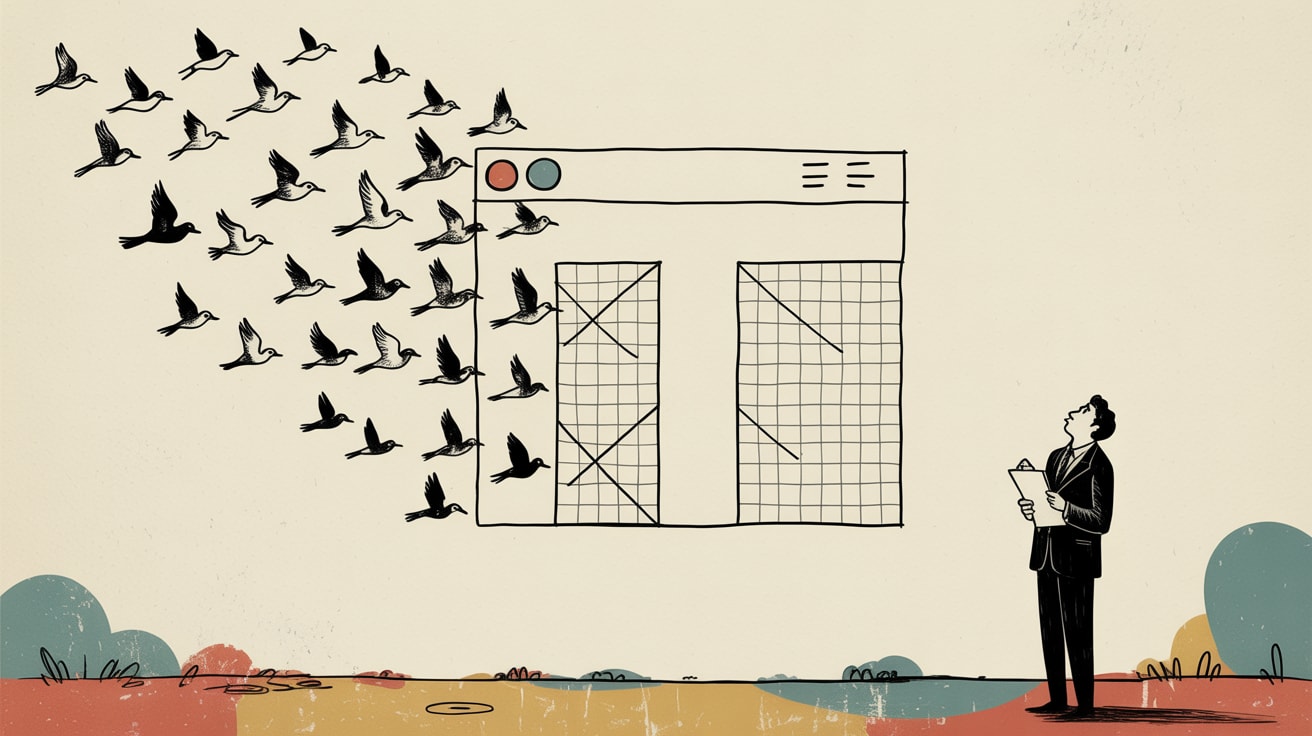
The shift isn’t from process to chaos. It’s from hierarchical bottlenecks to something more like a flock — individual agents with shared principles, capable of coherent collective response without centralised instruction.
The Validation Gap That’s Quietly Killing Good Design Work
AI has collapsed prototype build time. A mid-level designer with access to the right tools can assemble a testable interface in 48 hours. The problem is that user research hasn’t kept pace — most teams are still running validation cycles that take two to three weeks, which means they’re testing decisions that are already being second-guessed.
This creates a specific failure mode: teams ship based on assumption because the feedback loop is too slow to be useful. In markets like Vietnam or Indonesia, where digital behaviour is evolving rapidly and mobile-first usage patterns don’t always mirror the assumptions baked into Western research templates, that gap is expensive.
The practical fix isn’t revolutionary — it’s operational. Embed lightweight validation into the build cycle rather than treating it as a downstream phase. Test Figma prototypes with five users before the design review, not after engineering has already built the component. If your stakeholder review meeting is the first moment a real human interacts with a new pattern, you’ve already lost a week.
For teams managing multilingual interfaces across Thai, Bahasa, Vietnamese, and Tagalog — where a layout that breathes in English collapses under longer strings — in-flight validation isn’t optional. It’s the only way to catch localisation failures before they reach production.
What Ian Teeple’s Photocopied Punk Posters Have to Do With Your Design System
This might seem like a detour, but stay with me.
Graphic designer Ian Teeple makes gig posters using ink, oil pastels, crayons, paint, collage, and repeated photocopying — running the same image through a machine multiple times until it accumulates noise, texture, and a particular kind of visual aggression. The output looks like it’s been through a mosh pit. That’s the point.
What Teeple is doing, deliberately, is introducing constraint-driven degradation as a design tool. Each photocopy pass removes fidelity and adds character. The final artifact carries evidence of its own process.
For brand design teams, the lesson isn’t aesthetic — it’s structural. The most distinctive visual identities aren’t the ones with the most precise design systems. They’re the ones where a core set of constraints has been applied with enough pressure, repeatedly, that the output starts to feel inevitable. Teeple’s posters couldn’t be mistaken for anyone else’s work. Can your brand’s digital touchpoints say the same?
In practice, this means fewer brand guidelines and more brand constraints: a small number of rules applied with genuine conviction across every surface — app UI, Shopee storefront banners, LINE OA push notifications, OOH. Not pixel-perfect consistency, but recognisable tension. The difference between a design system that produces sameness and one that produces identity.
The failure mode to avoid: design systems that become museums. Teeple’s work is loud because it’s in active use, accumulating marks. Systems that aren’t stress-tested against real production conditions — real copy lengths, real image asset quality, real localisation — calcify quietly and break publicly.
Building Creative Leadership That Doesn’t Crack Under Pressure
The through-line across all of this is judgment — and how organisations either distribute it or hoard it.
Design leadership that centralises every significant call in one or two senior people creates an obvious bottleneck. It also creates fragility: when those people leave, pivot, or burn out, the team loses its decision-making capacity overnight. UX Collective’s framing of the ‘swarm and flock’ model is worth taking seriously here — not as an org chart exercise, but as a genuine rethinking of where design authority should live.
For Southeast Asian brands managing design across multiple markets simultaneously, this is especially relevant. A design director in Singapore cannot be the single point of judgment for UX decisions affecting teams in Manila, Jakarta, and Bangkok. Local designers need the principles, the context, and the permission to make calls — and the psychological safety to know that a wrong call won’t end their career.
Building that culture requires two concrete investments: shared design principles that are specific enough to guide real decisions (not ‘we value simplicity’ but ‘we reduce cognitive load by surfacing one primary action per screen’), and regular retrospective practice that treats design failures as data rather than blame events.
The brands that will build durable design capability in this region aren’t the ones with the most sophisticated tooling. They’re the ones that have figured out how to put judgment in the hands of the people closest to the problem.
Key Takeaways
- Replace centralised design approval chains with distributed principles — document specific decision rules, not aesthetic values, so local teams can move without waiting for sign-off.
- Embed user validation into the build cycle at the prototype stage, not after engineering handoff — in multilingual SEA markets, this is where localisation failures surface earliest and cheapest.
- Treat your design system as a constraint set under active pressure, not a museum of approved components — stress-test it against real production conditions across every channel it touches.
The real question for design leaders in 2026 isn’t which AI tool accelerates production — it’s whether the humans on your team have enough judgment to decide when the AI output is wrong. That’s a culture question, not a tooling question. And it’s one most design organisations haven’t seriously answered yet.
At grzzly, we work with marketing and growth teams across Southeast Asia who are grappling with exactly this challenge — building design capability that scales across markets, moves fast enough to be relevant, and doesn’t collapse the moment the brief changes. If you’re rethinking how your design function operates, or trying to close the gap between creative quality and commercial output, we’d like to think through it with you. Let’s talk
Sources

Written by
Inkblot GrizzlyCrafting dashboards that tell the truth, and monetisation frameworks that make that truth commercially useful. Turns abstract data assets into revenue-generating products for publishers and brands alike.