
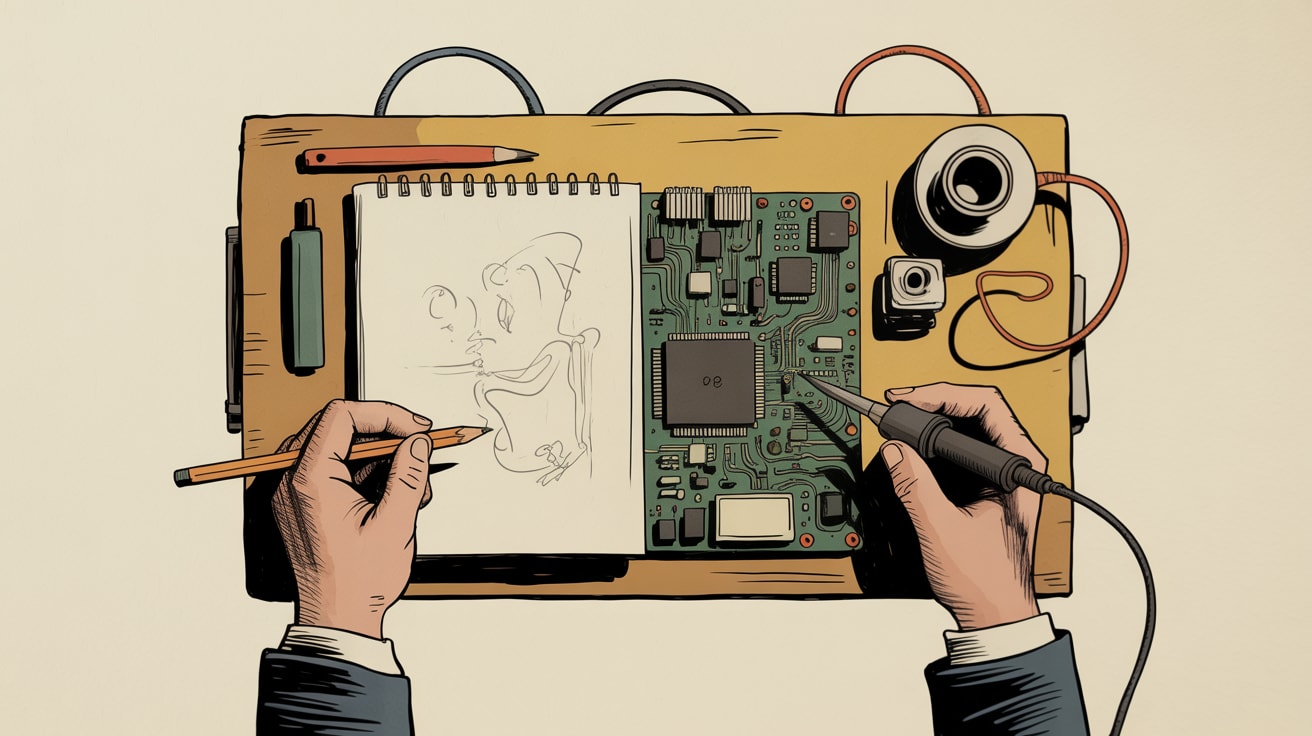
Design engineers are blurring the line between UX and dev. Here's what that means for brand output, team structure, and your next hire in Southeast Asia.
Figma’s stock dropped nearly 12% the morning Google formally launched Stitch, its AI-native design tool. That number is a data point, but the real signal is structural: the boundary between design and engineering is dissolving faster than most brand teams have planned for.
The Design Engineer Isn’t a Hybrid — It’s a New Discipline
UXDesign.cc’s Fabricio Teixeira flagged something important in a recent roundup: despite the explosion of job titles in this space, design engineering has a distinct genetic code. It isn’t a designer who can code, or a developer with aesthetic sensibilities. As Anna Lefour articulates, it’s a discipline that lives specifically at the seam — where design decisions meet technical implementation, and where the cost of misalignment is highest.
For Southeast Asian brands running campaigns across Shopee, LINE, and their own apps simultaneously, that seam is where inconsistency breeds. A design system looks immaculate in Figma. Then it hits a Shopee product listing template, a LINE OA rich menu, and a web landing page — and the visual language fragments. A design engineer doesn’t just hand off; they own the translation layer. That’s a fundamentally different accountability than a traditional UX role.
The business case is straightforward: reduced QA cycles, fewer revision loops between creative and dev, and brand assets that actually render as intended across platforms with wildly different UI conventions.
Google Stitch and the ‘Vibe Design’ Problem
The launch of Google Stitch — and the market’s nervous reaction to it — surfaces a genuine strategic question for design teams: which parts of their workflow are commodity, and which require judgment that no tool can replicate?
Elvis Hsiao’s critique of “Vibe Design” (the idea that AI can generate polished UI from a loose prompt) is pointed: aesthetic output without strategic intent is just decoration that happens to be on-brand. For a dashboard product or a monetised data platform, that distinction has direct revenue implications. A chart that looks clean but obscures the conversion signal it’s meant to surface isn’t a design win — it’s a liability dressed in a good typeface.
What Stitch and tools like it actually accelerate is the commoditisation of execution. If generating a component library or a wireframe variant takes minutes instead of days, the value of a design team shifts decisively toward the decisions that precede generation: information hierarchy, business logic embedded in visual structure, and the ability to tell a stakeholder why a layout choice affects retention.
Design Maturity Is Now a Revenue Variable
Teixeira’s curation this week also touched on design maturity frameworks — and this is where the conversation gets commercially interesting. A mature design system isn’t just operationally efficient; it’s a monetisation asset. Publishers and platform businesses that have invested in scalable, component-based design systems can spin up new ad formats, native content units, or data product interfaces without rebuilding from scratch each time.
In Southeast Asia, where digital ad inventory is increasingly programmatic and platform-native, the brands that can rapidly adapt creative to platform specs — Lazada’s A+ content modules, Grab’s in-app placements, LINE’s card-based messaging formats — without losing visual coherence are compounding a structural advantage. That advantage is built in the design system, not in individual campaign executions.
The practical implication: design maturity investment should be framed to CFOs not as a quality initiative, but as a speed-to-revenue multiplier. A brand that can execute a new channel integration in two weeks instead of six is capturing inventory windows its competitors miss.
What This Means for Your Next Design Hire (or Brief)
The convergence of AI tooling and design engineering as a discipline forces a concrete resourcing question: are you hiring for execution, or for judgment at the implementation layer?
For most mid-to-large brand teams in the region, the answer should be shifting toward the latter. AI handles an expanding share of execution. What it doesn’t handle is knowing which metric the dashboard should make unmissable, or how a color decision in a Grab banner maps back to brand equity being built on a flagship website.
Three practical moves: First, audit where your current design-to-dev handoffs break down — that’s where a design engineer would pay for themselves fastest. Second, pressure-test your design system against your three most important platforms; if it requires significant manual adaptation for each, you don’t have a system, you have a style guide. Third, when briefing AI design tools, treat the prompt as a strategic document — garbage intent in, polished garbage out.
The open question worth sitting with: As AI tools compress the execution timeline to near-zero, does design leadership become more valuable — or does it become harder to justify to a board that sees “design” as a cost centre that machines are rapidly replacing?
At grzzly, we work with brand and growth teams across Southeast Asia on exactly this intersection — building design systems that hold across platforms, and helping teams structure creative workflows that don’t fall apart when AI enters the room. If your design-to-revenue pipeline has gaps you haven’t been able to name yet, that’s usually the most interesting place to start. Let’s talk

Sources

Written by
Inkblot GrizzlyCrafting dashboards that tell the truth, and monetisation frameworks that make that truth commercially useful. Turns abstract data assets into revenue-generating products for publishers and brands alike.