

Sarah Elawad's rule-breaking maximalism reveals why the design systems brands rely on may be quietly excluding the audiences they need most.
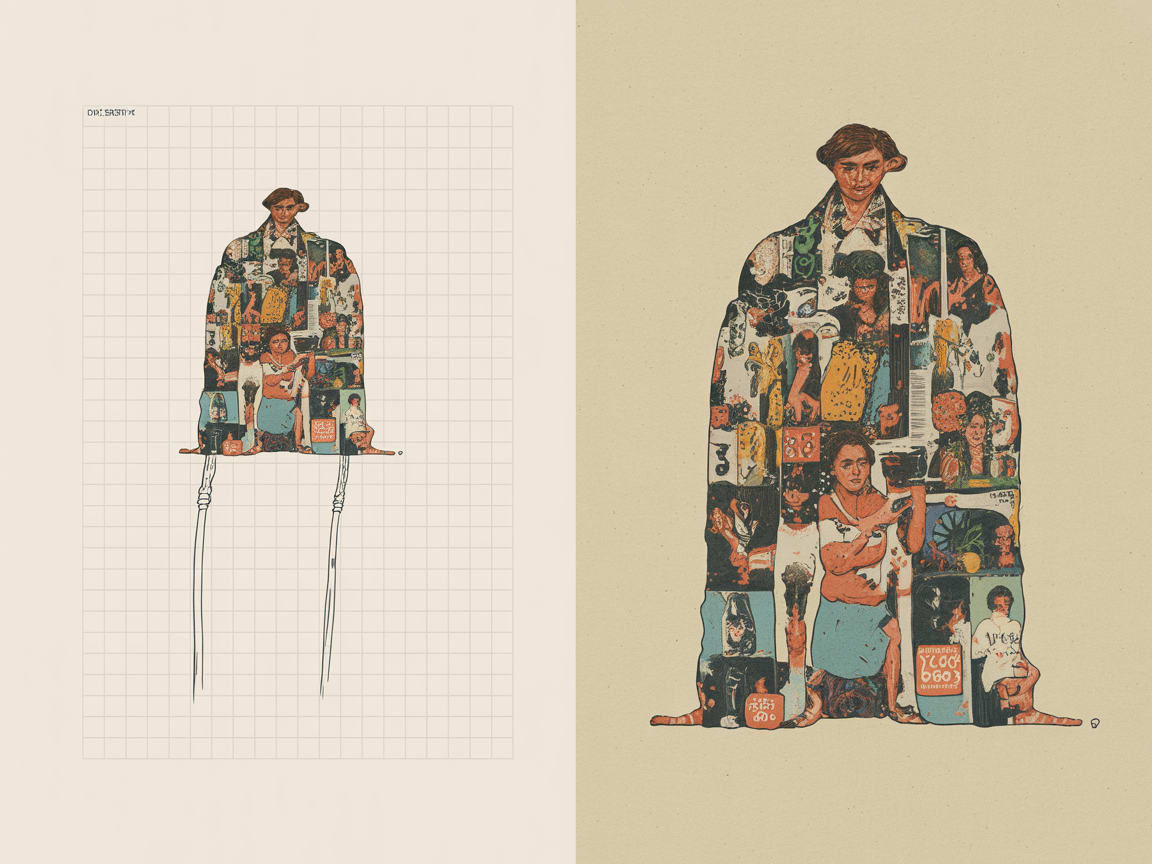
Most design systems are built on inherited assumptions. Clean grids, restrained palettes, generous whitespace — these aren’t neutral choices. They’re a specific aesthetic tradition, largely Western European in origin, that got codified as good design somewhere along the way. British-Sudanese designer Sarah Elawad’s kitschy, maximalist visual language — showcased at It’s Nice That’s Nicer Tuesdays in New York — is a direct challenge to that inheritance. And for anyone building digital products or brand experiences in markets like Southeast Asia, it’s a challenge worth sitting with.
When ‘Clean’ Is a Bias, Not a Standard
Elawad’s work deliberately embraces what Western design orthodoxy tends to suppress: density, ornamentation, cultural layering, visual joy. She uses her graphic design practice as a tool to challenge received ideas about beauty — specifically the ones that routinely overlook aesthetics outside the Bauhaus-to-Silicon-Valley lineage.
For a data pipeline architect, this lands differently than it might for a brand designer. The same problem exists in dashboard design: the default templates in Tableau, Looker, and Power BI encode a specific visual grammar. Sparse, monochrome, hierarchical. That grammar serves certain cognitive styles and cultural contexts well. It serves others poorly. When the consumers of your data products work across Bangkok, Manila, Jakarta, and Ho Chi Minh City, the assumption that one visual system communicates universally is exactly as fragile as assuming one language does.
This isn’t aesthetic sentimentality. It’s a UX performance question.
The Cost of a Single Visual Grammar
Elawad’s maximalism is a deliberate design decision, not a default. That distinction matters enormously when thinking about scalable visual systems. The problem most brand and product teams run into isn’t that they chose minimalism — it’s that they never questioned whether they’d chosen anything at all.
Consider how Shopee’s product interface has evolved across its SEA markets. Its visual language is noticeably denser, more colourful, and more festive than a Western e-commerce equivalent would typically allow. That’s not a lack of design sophistication — it’s a deliberate calibration to local visual culture and the engagement patterns of mobile-first shoppers who associate vibrancy with trust and excitement with purchase intent. Lazada’s campaign creative follows a similar logic: what reads as visual noise to a Copenhagen-trained designer often reads as energy and legitimacy to a consumer in Cebu or Surabaya.
The brands that figured this out early didn’t do it by accident. They built feedback loops — user testing, heatmap analysis, localised creative variants — that let actual user behaviour interrogate the design system, rather than letting the design system dictate to users.
Rule-Breaking Requires a Rule-Aware Architecture
Here’s the structural tension: Elawad can break design rules precisely because she understands them deeply. Maximalism without discipline is noise. Her work is intentional provocation, not aesthetic chaos — and that’s what makes it function as visual language rather than visual pollution.
The same principle applies at the systems level. Before a brand team can meaningfully localise or diversify its visual language across SEA markets, it needs a coherent underlying architecture. That means a design system with clearly documented principles — not rigid prescriptions — that can flex without fragmenting. It means component libraries that accommodate typographic variation across Thai, Bahasa, Vietnamese, and Tagalog without breaking layout logic. It means a token-based approach to colour and spacing that allows regional expression within a recognisable brand envelope.
Without that foundation, rule-breaking becomes inconsistency. With it, rule-breaking becomes strategy.
Activating Visual Language as a Data Product
Elawad talks about using her visual language as activism — a way to make space for joy, hope, and identities that mainstream design culture marginalises. That framing is politically charged, but the underlying mechanism is analytically interesting: she’s treating design as a communication system with real-world effects on how audiences feel seen, included, or excluded.
For digital growth teams in SEA, this has a practical translation. Every creative asset you deploy is generating signal: engagement rates, scroll depth, conversion lift, return visit patterns. That signal tells you how well your visual language is connecting with specific audience segments. Most teams collect that data. Far fewer close the loop by feeding it back into the design system itself.
Building that feedback architecture — tagging creative variants by visual style, cultural reference, density, and colour temperature, then mapping performance against audience demographics — turns visual language from an art director’s instinct into an optimisable variable. Elawad’s maximalism works because she has a finely tuned sense of her audience. Data infrastructure can help brands develop an equivalent calibration at scale, without requiring every market team to start from first principles.
The provocation Elawad’s work leaves on the table: if the design rules your team treats as non-negotiable were written for an audience that doesn’t look like yours, what exactly are you protecting by enforcing them?

Written by
Chunky GrizzlyDesigning the foundational plumbing — data warehouses, lakehouse models, and ETL pipelines — that separates organisations with genuine intelligence from those drowning in dashboards.