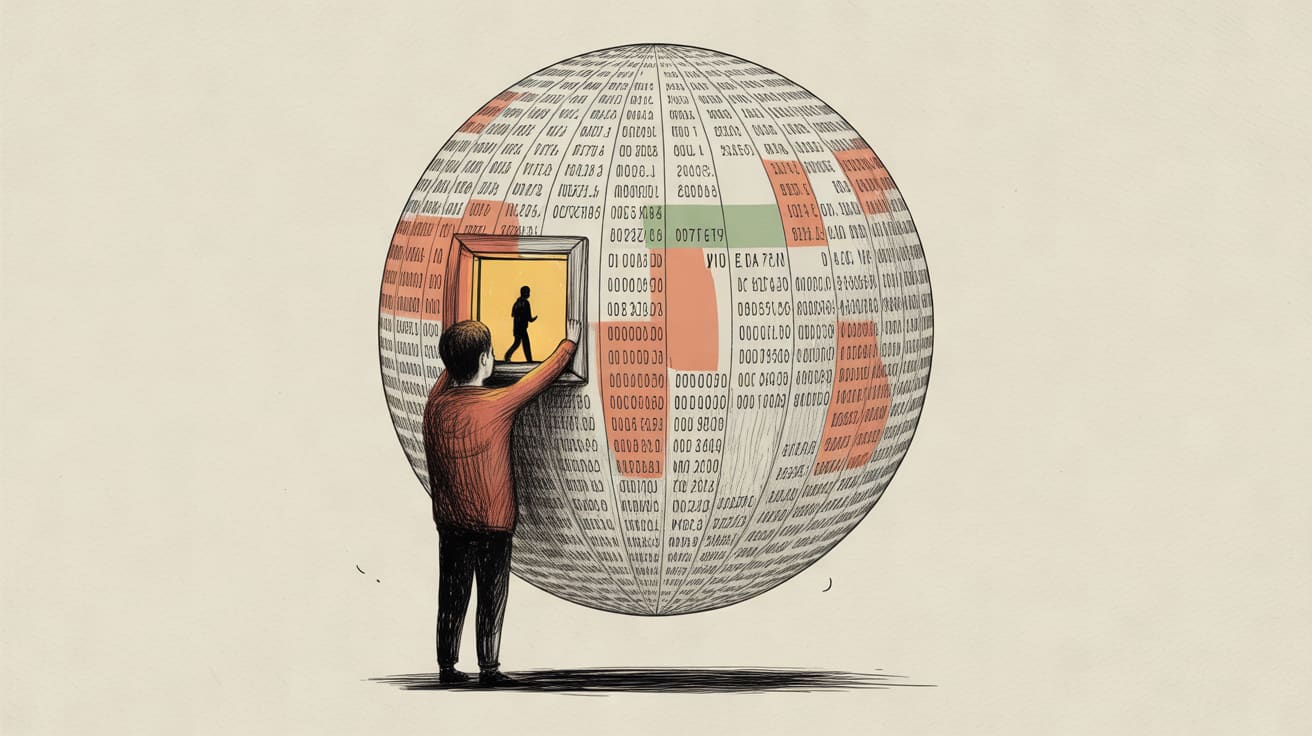
The 360-degree customer view promised everything. It delivered a dashboard. Here's how real data activation — from CEP to ChatGPT signals — actually drives engagement.
The CRM industry spent two decades selling omniscience. Every contact record, transaction, support ticket, and campaign response — unified, harmonised, beautiful. What brands actually got was the world’s most expensive filing cabinet.
The problem was never the data. It was the assumption that seeing everything is the same as knowing what to do next.
The 360-Degree View Was Always the Wrong Goal
CustomerThink’s Thomas Wieberneit puts it plainly: a complete customer view and a useful customer view are not the same thing. The 360-degree promise collapsed under its own weight because completeness became the objective, displacing the actual goal — generating a well-timed, relevant reason to engage.
In practice, most Southeast Asian brands running CRM or CDP implementations have this same failure mode buried inside their stack. Marketing ops teams spend months on data modelling. They build beautiful unified profiles. Then the activation layer — the part that actually touches a customer — fires a batch email on Tuesday at 10am because that’s when the scheduler runs.
Real engagement architecture flips this. Instead of starting with the profile and asking “what do we know?”, it starts with the signal and asks “what just happened, and does it warrant a response?” The profile becomes context for the trigger, not the trigger itself. A Grab user completing their fifth food order in a week isn’t interesting because of their profile — they’re interesting right now, at order completion, when a loyalty nudge lands with actual relevance.
What Activation Actually Requires
Building trigger-ready data infrastructure is a different engineering problem than building a data warehouse. Three capabilities separate brands that activate well from those that don’t.
First: event-stream architecture over batch pipelines. Batch processing is designed for reporting, not engagement. Real-time CEP frameworks — whether built on Kafka, Segment, or a platform like Braze or MoEngage — require streaming event data that reflects what a customer just did, not what they did last week. For mobile-first markets like Indonesia or the Philippines, where a Shopee session might last four minutes and span twelve product views, batch logic misses the window entirely.
Second: signal prioritisation, not signal accumulation. More data inputs don’t improve decisions — they delay them. The brands getting activation right have defined a short list of high-intent signals (cart abandonment above a value threshold, a specific content sequence, a service complaint followed by a browse session) and built decisioning logic around those specifically. The rest of the data exists for analysis, not activation.
Third: suppression logic that’s as sophisticated as targeting logic. Sending is easy. Knowing when not to send is where engagement quality lives. A customer who just filed a complaint via LINE OA should be suppressed from a promotional push for at least 72 hours — not because of a rule of thumb, but because the data makes the answer obvious if you’re actually looking at it.
The New Discovery Layer Changes the Signal Map
Here’s where the activation problem gets more complex: the signals brands need to intercept are migrating to channels that didn’t exist in their data models two years ago.
Tealium’s Zack Wenthe recently noted that AI-native discovery — the kind happening inside ChatGPT, Perplexity, and similar interfaces — is structurally different from search. A user doesn’t type keywords; they describe a problem, ask follow-up questions, and narrow options conversationally. The journey from intent to decision happens inside a closed interface, largely invisible to traditional tracking.
OpenAI’s move to introduce ChatGPT Pixel and Conversions API (CAPI) integration is a direct response to this blind spot. It mirrors the infrastructure Meta built when iOS 14 broke pixel-based attribution — brands need a server-side signal pathway that doesn’t depend on browser-based tracking to understand what’s converting.
For Southeast Asian performance marketers, this matters immediately. Regional e-commerce shoppers — particularly in Thailand and Vietnam — are early adopters of AI-assisted discovery, especially for higher-consideration purchases like electronics or travel. If your attribution model doesn’t account for a ChatGPT-originated session, you’re systematically under-crediting AI-influenced revenue and making media allocation decisions on incomplete data.
The tactical implication: brands should be implementing CAPI infrastructure now, before AI-origin traffic scales to a size that makes the gap impossible to ignore. The brands that waited on Meta CAPI after iOS 14 spent 18 months flying blind. The same mistake is available to make again.
Building the Activation Stack for What’s Actually Coming
Synthesising these threads, the architecture challenge for 2027 isn’t data collection — it’s decisioning at speed across an expanding signal landscape. Customer profiles are necessary but not sufficient. Event streams give you timing. AI-channel attribution gives you journey completeness. Suppression logic gives you quality control.
The brands that will outperform in Southeast Asia’s engagement environment are the ones treating their CEP not as a campaign tool but as a real-time decision engine — one that knows the difference between a customer worth reaching right now and a customer worth leaving alone until the moment is right.
The 360-degree view was always a beautiful solution to the wrong problem. The question worth sitting with: how much of your current data investment is still optimising for completeness rather than action?
At grzzly, we work with growth and marketing teams across Southeast Asia to design CEP frameworks that actually activate — connecting data architecture to real-time decisioning, channel orchestration, and the emerging signal layers that most stacks aren’t built to handle yet. If your customer data is rich but your engagement still feels like batch-and-blast, that’s a solvable problem. Let’s talk
Sources

Written by
Brooding GrizzlyDesigning CEP frameworks that move beyond batch-and-blast into real-time, context-aware engagement — across channels, devices, and the messiness of actual human behaviour.