
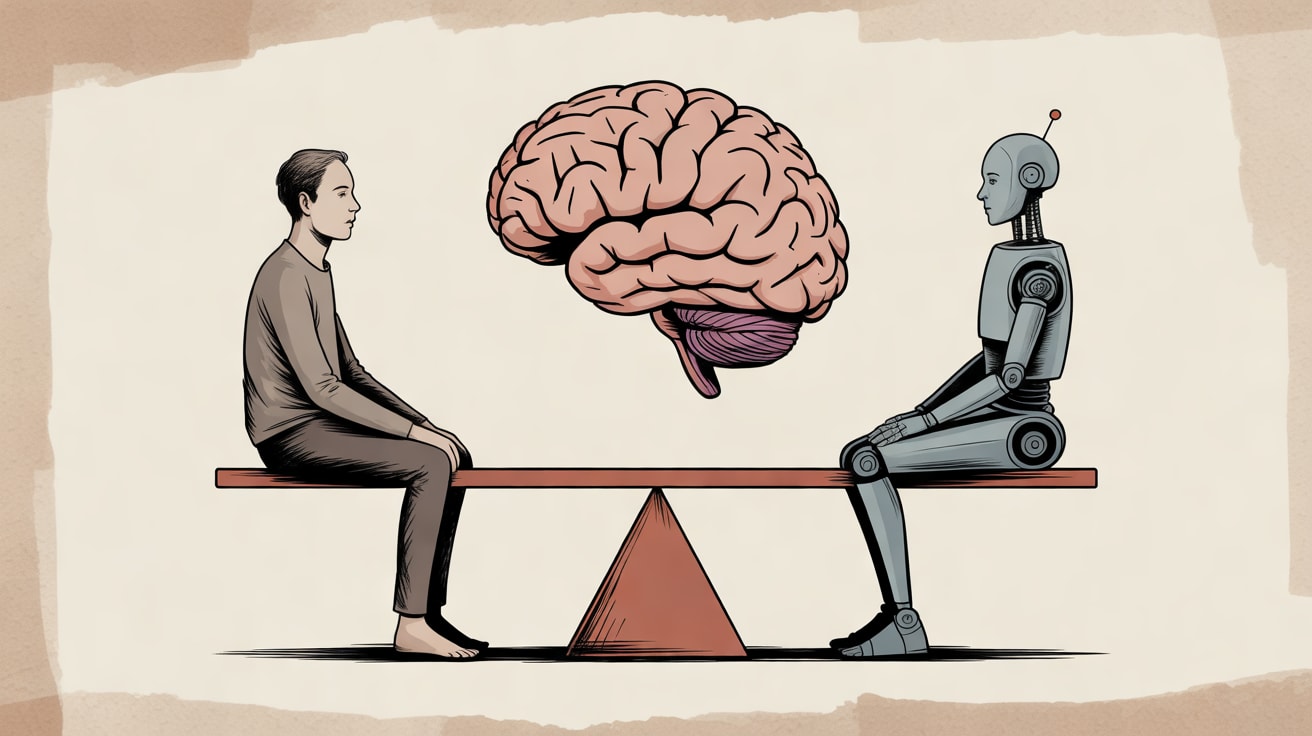
AI is quietly eroding the judgment UX teams rely on most. Here's what's at stake for design quality in Southeast Asia — and how to stop the rot.
UX teams across Southeast Asia have never been faster. They’ve also, quietly, never been more dependent on a tool that can’t tell you why a button feels wrong.
The efficiency gains from AI-assisted design are real and documented. But UX Collective contributor Slava Polonski, PhD, raises an uncomfortable counterpoint: cognitive offloading — the act of delegating thinking to AI — doesn’t just accelerate output. Over time, it degrades the underlying judgment that made the output worth anything in the first place. This is skill atrophy, and it’s happening inside design teams right now, largely unnoticed because the dashboards still look green.
What Gets Lost When AI Does the Thinking
The problem isn’t that AI generates wireframes or suggests component names — it’s that designers stop practising the reasoning that precedes those decisions. Polonski’s analysis points to a well-established psychological principle: skills deteriorate without deliberate use. When a designer consistently accepts AI-generated user flows without interrogating the logic, they gradually lose the ability to construct that logic independently.
This isn’t hypothetical. Consider how naming conventions — something as foundational as what Vitaly Friedman unpacks in Smashing Magazine’s recent practical guide — require disciplined, contextual thinking: understanding component hierarchy, anticipating edge cases, designing for team scalability. When AI autocompletes a component name, the designer gets an answer but skips the reasoning. Multiply that across a design system serving a multilingual Southeast Asian platform — Bahasa, Thai, Vietnamese rendering in the same UI — and the downstream cost of shallow naming decisions becomes very concrete, very fast.
Speed Without Judgment Is Just Expensive Noise
The agency pricing debate adds another dimension here. Speckyboy’s Eric Karkovack makes the case that AI-assisted WordPress development shouldn’t automatically mean lower client fees, because expertise, testing, and strategic planning still drive value — the AI just compresses certain mechanical tasks. The same logic applies to UX. A designer who uses AI to generate ten layout variants in an hour is only valuable if they can evaluate those variants against real user behaviour data, business constraints, and cultural context.
In Southeast Asia, that context is non-trivial. Mobile-first isn’t a design principle here — it’s a baseline reality, with Shopee and Grab setting UI expectations that differ meaningfully from Western app conventions. An AI trained predominantly on Western design corpora will surface patterns that feel subtly off to a Jakarta or Manila user. The human designer who has internalised local UX norms is the quality filter. If that judgment has atrophied, no amount of AI throughput compensates.
The Data Pipeline Analogy (Bear With Me)
From where I sit — thinking about data architecture and pipeline integrity — this pattern is familiar. Organisations that automate data ingestion without maintaining human fluency in what the data actually represents end up with clean pipelines full of meaningless signals. The dashboard looks healthy. The decisions downstream are quietly terrible.
AI-assisted design has the same failure mode. The output looks polished. The reasoning underneath is hollow. And unlike a broken ETL job, hollow design reasoning doesn’t throw an error — it ships, gets iterated on, and compounds. By the time a brand notices that its app conversion rate has plateaued despite constant UI updates, the team has lost the diagnostic instincts to understand why.
The fix isn’t to abandon AI tooling — that’s not a serious position. It’s to build deliberate friction back into the process. Require designers to articulate the reasoning behind AI-generated suggestions before accepting them. Run regular “no AI” sprints where teams solve problems with pen, paper, and peer critique. Treat the articulation of design rationale — not just the artefact — as a deliverable. This is how you maintain the human layer that makes AI output actually useful.
Implementation Without the Atrophy Trap
Practically speaking, teams need structural safeguards, not just good intentions. Three that work:
Rationale documentation as standard practice. Every significant design decision — layout choice, navigation pattern, component naming — gets a one-sentence human-authored justification logged in the design system. This forces the thinking AI would otherwise bypass, and creates institutional memory that doesn’t evaporate when someone leaves the team.
Staged AI involvement. Use AI for divergent phases (generating options, identifying patterns in user research) and reserve convergent phases (prioritisation, final decisions, edge-case resolution) for human judgment. This mirrors how strong data teams use automated pipelines for ingestion and transformation, but keep humans in the loop for interpretation and action.
Cross-market stress testing. Before any AI-generated UI pattern is adopted at scale, run it against your most demanding market context — typically a lower-bandwidth, multilingual, mobile-only segment. If the pattern holds up there, it holds up everywhere. If it doesn’t, you’ve caught it before it becomes a design system default.
The goal isn’t to slow teams down. It’s to ensure that when AI eventually gets something wrong — and it will — there’s a human in the loop who still knows how to catch it.
Key Takeaways
- AI-generated design artefacts are only as valuable as the human judgment evaluating them — maintain that judgment deliberately or lose it gradually.
- In Southeast Asian markets, local UX fluency (mobile-first conventions, multilingual interfaces, platform-specific patterns) is exactly the skill AI is worst at replicating and most likely to erode through overuse.
- Build rationale documentation and staged AI involvement into team workflow — not as bureaucracy, but as the structural equivalent of keeping your data pipelines auditable.
The real competitive question for design teams in the next two years isn’t “how much AI are we using?” — it’s “what are we doing to ensure our human judgment stays sharper than our AI’s defaults?” The organisations that treat that as a systems problem, not a motivation problem, are the ones that will still be able to design their way out of a crisis when the AI gives them confident nonsense.
At grzzly, we work with marketing and digital teams across Southeast Asia who are navigating exactly this tension — building AI-assisted workflows that accelerate output without hollowing out the strategic thinking underneath. If your team is moving fast but losing confidence in why the decisions are right, that’s worth a conversation. Let’s talk
Sources

Written by
Chunky GrizzlyDesigning the foundational plumbing — data warehouses, lakehouse models, and ETL pipelines — that separates organisations with genuine intelligence from those drowning in dashboards.