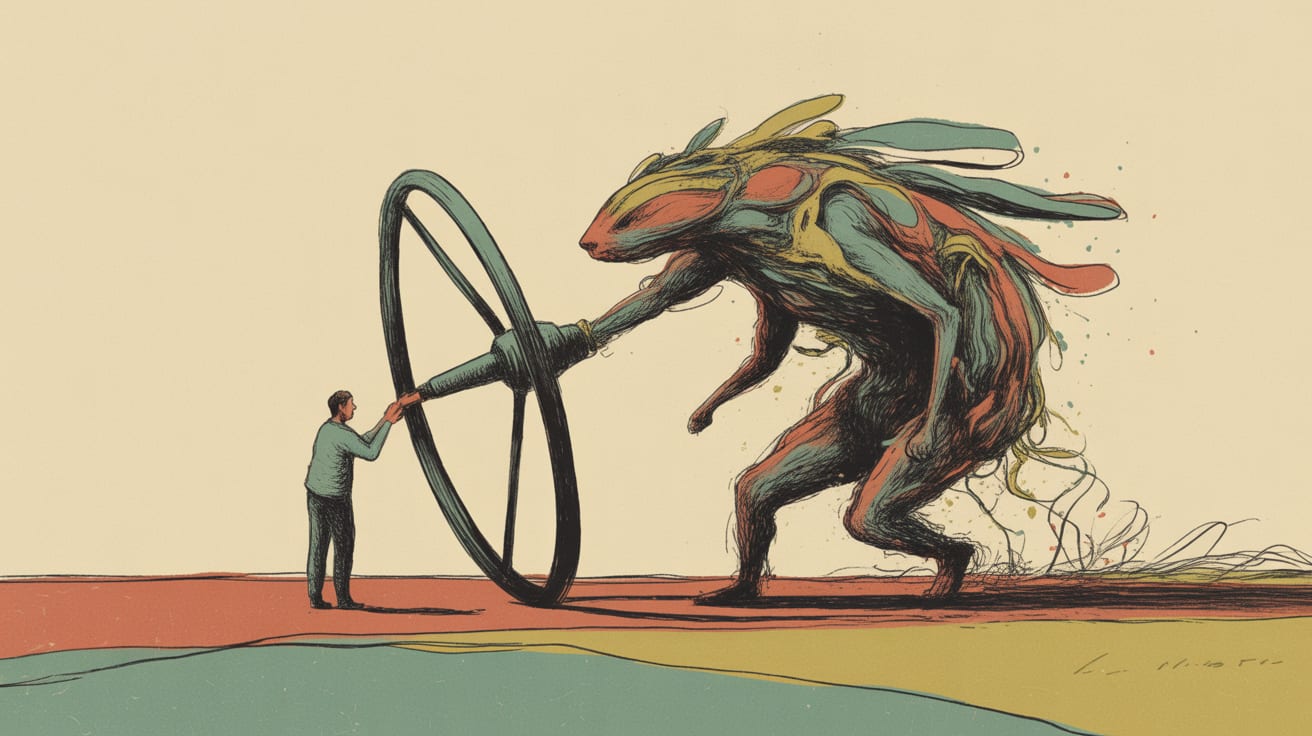
AI governance and UX design share the same flaw: both treat living systems like monuments. Here's what Southeast Asian teams should do differently.
AI is eating design from the inside out — and most teams are still writing the rules for a system that has already moved on.
That tension sits at the heart of a sharp observation from UX Design’s Fabricio Teixeira this week: governance bodies are approaching AI the way waterfall teams approached software — one comprehensive bill, fully specified, passed once. The internet’s builders would have found that laughable. They governed a moving target by treating governance itself as a product. Design leaders in Southeast Asia have the same choice to make right now, not about legislation, but about how they build and manage design systems in an AI-augmented world.
The Waterfall Trap Is Alive in Your Design System
Here’s an uncomfortable data point: most enterprise design systems are updated quarterly at best, while the AI tools generating UI components, copy variations, and personalised layouts operate on a daily inference cycle. That’s a governance gap wide enough to drive a Grab truck through.
The structural problem is familiar to anyone who has worked in data architecture. You build a schema for the data you have today, then the business changes and the schema becomes a constraint rather than a foundation. Design systems built as monuments — comprehensive, beautiful, signed off by a committee — face the same entropy. Shopee’s design team, for instance, has had to continuously evolve its component library to accommodate dynamic seller storefronts, promotional burst periods, and localised UI patterns across six markets simultaneously. That is not a quarterly-update problem; that is a continuous deployment problem.
The fix is not to design less rigorously. It’s to build review cadences into the system itself — automated flagging when AI-generated outputs deviate from brand tokens, lightweight governance checkpoints rather than heavyweight approval gates.
Documentation as a Design Asset, Not an Afterthought
AI-assisted documentation is quietly becoming one of the highest-leverage interventions available to design and development teams. Speckyboy recently explored how AI tooling can maintain living records of code changes, feature rationale, and implementation decisions in WordPress environments — but the principle scales directly to design systems.
From a data activation perspective, undocumented design decisions are equivalent to dark data: they exist, they influence outcomes, but they cannot be queried, audited, or improved. When a UX team in Bangkok hands off a component to a development team in Manila, the delta between design intent and built output is almost entirely a documentation failure.
Practical starting point: use AI to auto-generate a decision log every time a design token is modified. Capture the before state, the after state, and a plain-language rationale. Three months of that produces a searchable audit trail that makes design reviews faster, onboarding cheaper, and stakeholder alignment dramatically less painful. The tooling exists — the discipline to implement it is the actual bottleneck.
Variance Is the Real UX Problem AI Creates
Teixeira’s curation this week also surfaces what he calls “the variance problem” — a concept that deserves more attention in design conversations than it currently gets. When AI generates UI copy, product descriptions, or personalised layout variations at scale, it introduces statistical variance that individual QA processes cannot catch.
For Southeast Asian teams running multi-language interfaces — Bahasa Indonesia, Thai, Vietnamese, Tagalog, often simultaneously — the variance problem compounds. A generative model producing Bahasa copy for a Tokopedia campaign may produce outputs that are grammatically correct but culturally misaligned with the platform’s established voice. No single reviewer catches that at scale. The only viable solution is a measurement framework: define acceptable variance thresholds for tone, reading level, and cultural markers, then instrument your QA pipeline to flag deviations automatically.
This is fundamentally a data problem dressed in a design problem’s clothing. The teams that will get this right are the ones that stop treating AI-generated design outputs as creative artefacts to be reviewed by eye, and start treating them as model outputs to be monitored by metric. Build a small evaluation dataset of gold-standard UI copy per market, run automated similarity scoring against it, and surface anomalies for human review. The volume of AI-generated output makes any other approach unsustainable.
Steering Requires Knowing Where You Are
The broader strategic point across all three of these threads — governance, documentation, variance — is the same one that separates good data teams from great ones: you cannot steer something you cannot observe. The internet’s builders governed a technology in motion by instrumenting it obsessively. They did not wait for a complete picture before acting; they built the instruments first.
Design leaders in Southeast Asia are operating in one of the world’s most dynamic digital environments: markets where mobile-first is not a trend but a baseline, where platform ecosystems like LINE, Lazada, and Grab impose their own UI conventions, and where a single campaign may need to function coherently across five languages and three operating systems. The complexity is high enough that intuition alone breaks down. Observation systems — design analytics, documentation pipelines, variance monitoring — are not nice-to-haves. They are the steering mechanism.
The question worth sitting with: if your design system were a product, would it pass your own team’s definition of production-ready?
At grzzly, we work with digital and marketing teams across Southeast Asia to build the instrumentation layer that keeps design decisions connected to measurable outcomes — whether that’s governance frameworks for AI-generated content, analytics pipelines that surface UX variance, or design system audits that identify where brand consistency is quietly eroding. Let’s talk
Sources

Written by
Mellow GrizzlyTranslating raw data into activated audience segments, predictive models, and decisioning logic. Comfortable at the intersection of the data warehouse and the campaign manager.