
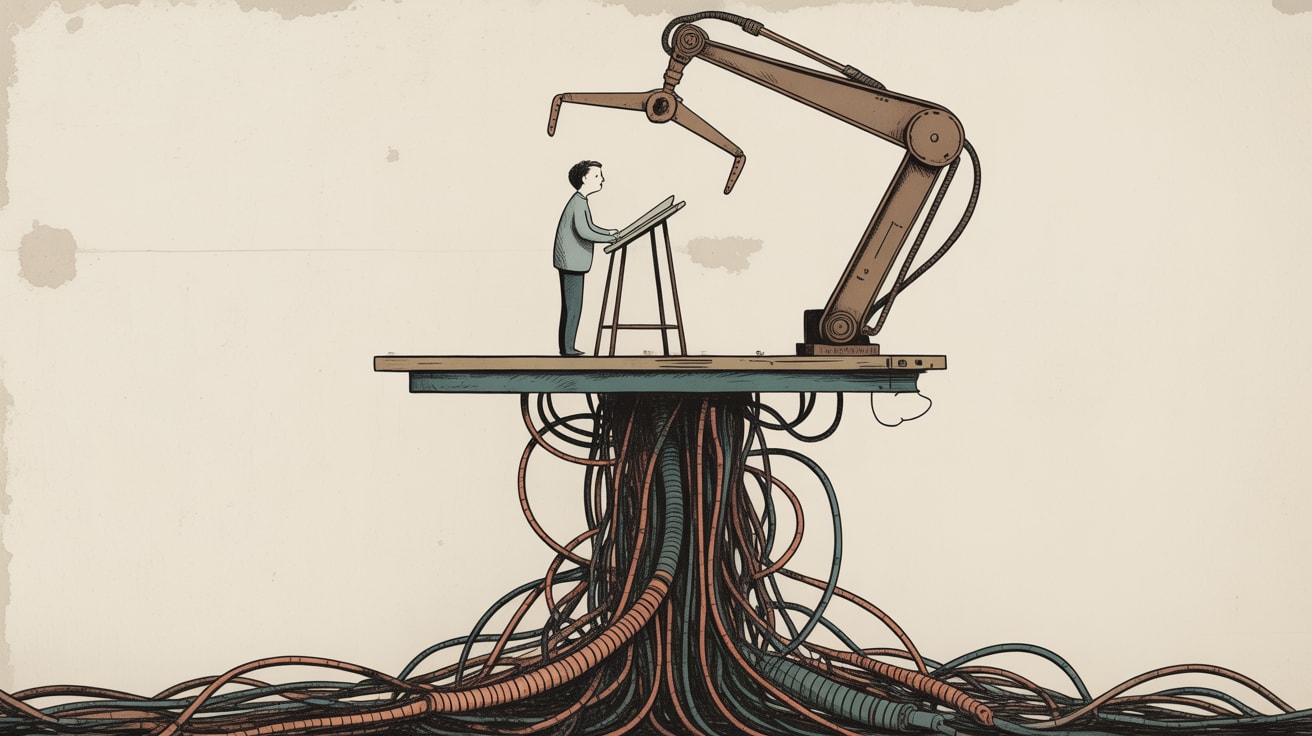
AI is giving designers more autonomy — but autonomy without data fluency exposes the gaps. Here's the bull and bear case for digital design in SEA.
Design teams in Southeast Asia are about to find out whether the last decade of craft actually composes into judgment — or whether it was always process dressed up as strategy.
Andy Budd’s recent analysis in Smashing Magazine frames it cleanly as a bull-and-bear split: AI either grants designers the autonomy to own end-to-end product decisions, or it ruthlessly exposes which designers were always dependent on organisational friction to hide limited strategic depth. Both outcomes are already playing out. The question is which side of that divide your team sits on.
The Bull Case: Autonomy as Acceleration
The optimistic read is genuine and grounded. When AI compresses the distance between idea and execution — generating interface variants, writing interaction copy, prototyping edge cases — designers who have always wanted to operate closer to business outcomes finally can. The permission structures that used to require three stakeholder reviews and a sprint cycle can collapse into a morning’s iteration.
For Southeast Asian brands competing on speed — think the pace of Shopee’s seasonal campaign cadences, or how quickly Grab has to push UI updates across six markets simultaneously — this compression is structurally valuable. A senior UX lead who previously needed a two-week design sprint to validate a checkout flow can now surface three tested variants in two days. That is not a marginal efficiency gain. That is a fundamentally different relationship between design and revenue.
The constraint, of course, is that autonomy is only as good as the judgment exercising it. And judgment requires a feedback loop — which means designers need to be comfortable sitting close to the data that tells them whether a decision worked.
The Bear Case: Autonomy Exposes the Gaps
Here is where it gets uncomfortable. Budd’s bear case is essentially this: AI removes the scaffolding that hid weak reasoning. When a junior designer could blame slow tooling or a backlogged developer for why a decision never shipped, there was cover. When AI removes those excuses, the gap between taste and judgment becomes visible immediately.
This is the pipeline problem I see consistently. Organisations invest in design systems, hire strong visual talent, and run rigorous usability testing — but the output never closes the loop back to conversion data, session recordings, or revenue attribution. The design team produces beautiful work. Nobody can tell you whether it moved the number.
In a pre-AI workflow, that gap was tolerable because it was expensive to close. Now it is not. AI-assisted analytics tools can surface which interface element correlated with a 14% drop in checkout completion on Android mid-funnel. If your design team cannot read that signal and respond to it, they are not more autonomous — they are more exposed.
The UX Collective’s recent piece on latency as a design dimension gestures at something related: when interfaces become faster and more reactive, users’ tolerance for friction shrinks proportionally. What felt acceptable at 800ms feels broken at 200ms. Design decisions that were good enough at lower fidelity become the source of churn at higher fidelity. The gap between craft and measurement closes whether you are ready or not.
What This Means for Southeast Asian Design Teams
The SEA context adds specific texture to this. Mobile-first is not a design preference here — it is a baseline constraint. Over 70% of e-commerce transactions in Indonesia and Vietnam happen on mobile devices, most on mid-range Android hardware with variable network conditions. A design decision that looks elegant in Figma on a MacBook can destroy load performance on a Redmi device on 4G.
This is exactly the kind of gap that AI-augmented workflows will surface faster than traditional QA cycles. Teams that have instrumented their design systems — tracking component-level performance, monitoring real-user metrics segmented by device class, attributing UI changes to session behaviour — will use AI to accelerate good decisions. Teams that have not will use AI to ship bad decisions faster.
The multi-language challenge compounds this. A CTA button that reads cleanly in English at 32px becomes truncated in Thai or Vietnamese at the same size. A design system that has not accounted for string length variance across six SEA languages will produce broken interfaces at scale, automatically, the moment AI starts generating localised copy at volume. The foundational plumbing has to be right before the tap runs faster.
The Skill That Actually Separates Them
Budd’s framing ultimately points to one capability as the differentiator: designers who can close the loop between a design decision and a measured outcome will compound their value in an AI-augmented environment. Designers who cannot will find that AI commoditises the parts of their job they were most confident in.
This is not about learning SQL. It is about developing enough fluency with data — session analytics, funnel attribution, A/B test interpretation — to have a conversation with the people who do. In practical terms: a UX lead at a regional retail brand should be able to sit in a data review, look at a funnel drop-off on a specific step, and form a testable hypothesis about the design cause. Then commission the test. Then read the result.
That loop — hypothesis, test, read, iterate — is what turns autonomy into compounding advantage rather than compounding risk.
Key Takeaways
- Build measurement into your design system before scaling AI-assisted production — component-level performance tracking and real-user metrics segmented by device class should be non-negotiable foundations.
- In SEA markets, test AI-generated design variants on actual mid-range Android devices under variable network conditions before treating Figma previews as directional truth.
- The designers who will benefit most from AI autonomy are those who already close the loop between design decisions and business outcomes — start building that fluency now, not after the tooling forces it.
The real question AI is asking design teams is not “can you use this tool?” It is “do you know what you are trying to achieve well enough to be trusted with more power?” That is the question Southeast Asian brands should be asking their design partners right now — and asking themselves.
At grzzly, we work with digital and marketing teams across Southeast Asia to build the data infrastructure that makes design decisions legible — connecting UI changes to downstream revenue signals so autonomy becomes an asset, not a liability. If your team is scaling design output and want to make sure the measurement layer keeps pace, Let’s talk
Sources

Written by
Chunky GrizzlyDesigning the foundational plumbing — data warehouses, lakehouse models, and ETL pipelines — that separates organisations with genuine intelligence from those drowning in dashboards.